
Why Does My Lower Back Hurt When I Wake Up?

Waking up with lower back pain or stiffness can make getting out of bed the hardest part of the day. Some people feel better after a warm shower or a short walk, while others notice an ache that lasts for hours. If you regularly wonder, “Why does my lower back hurt in the morning?”, the answer may involve your sleeping position, how your back responds to periods of rest, or a condition that needs assessment.
At Lakeside Chiropractic in Joondalup, we assess people with morning back pain and help them understand possible contributors. The starting point is to recognise that mechanical lower back pain does not always have one obvious cause, and that waking up sore does not automatically mean your mattress or spinal discs are damaged.
Why can lower back pain feel worse after sleeping?
The lower back has spent several hours with relatively little movement. When you change position for the first time in the morning, joints and muscles that feel stiff or sensitive may be uncomfortable until you begin moving. Some people also remain curled, twisted or extended in one position for much of the night, which can make their existing back symptoms more noticeable on waking.
Morning pain is a useful clue, but it is not a diagnosis. Notice whether the discomfort settles in five to fifteen minutes, remains for most of the morning, travels into a leg or interrupts your sleep. Those details often tell a clinician more than the fact that your back hurts first thing in the day.
Common causes of morning lower back pain
1. Muscle soreness and mechanical stiffness
Muscles surrounding the lumbar spine can feel tender after an unfamiliar workout, heavy lifting, gardening or a long day of sitting. Overnight rest may make that soreness more obvious when you first stand. In other cases, symptoms arise from the combined effect of muscle tension, joint sensitivity and how the back is loaded rather than a single injured structure. Read more about acute muscle strain and mechanical low back pain.
People who sit for much of the day may also notice a gradual build-up of discomfort. Movement breaks, changing positions and an appropriately paced exercise routine may help. Our article on sitting for long periods explains why varying your position matters.
2. Sleeping position and overnight support
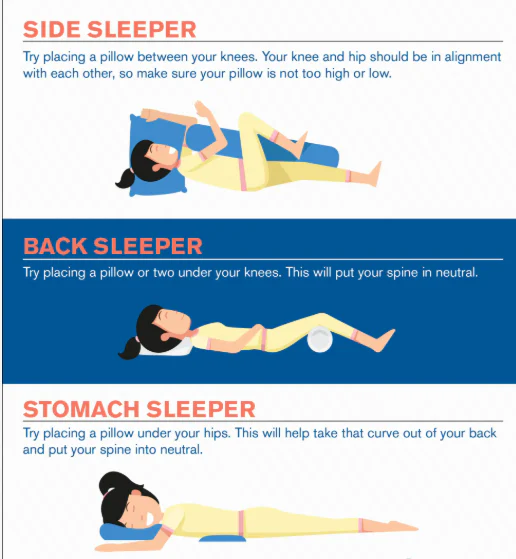
There is no single sleeping position that suits everyone. Some people with back pain find side sleeping more comfortable with a pillow between their knees, while others prefer lying on their back with a small pillow beneath the knees. Stomach sleeping may increase discomfort for people who are sensitive to back extension, but the best position is ultimately the one that allows comfortable, restful sleep. Our sleeping posture guide covers practical positioning ideas.
A pillow should support the neck without forcing the head too far upwards or sideways. For people comparing pillow shapes, Lakeside lists the Complete Sleeprrr Contoured Pillow among its clinic products. A pillow can affect comfort, but no particular pillow can reliably treat the underlying cause of lower back pain.
3. A mattress that does not feel supportive
A mattress that sags or leaves you uncomfortable in the same place each morning may contribute to disturbed sleep and aching. In one randomised trial, a medium-firm mattress was associated with better pain and disability outcomes than a firm mattress in adults with chronic non-specific lower back pain (1). That does not mean medium-firm is ideal for every body or every condition. Consider your comfort, preferred sleep position and whether your mattress is worn before replacing it solely because of back pain.
4. Age-related spinal changes and arthritis With age, discs and spinal joints naturally change. Some people with spinal arthritis or spinal degeneration experience stiffness after rest. However, these findings are also common in people without pain, so an X-ray or scan result should not be assumed to explain symptoms on its own. Examination findings and the way your pain behaves matter just as much.
5. Sacroiliac joint or pelvic-region discomfort Pain near one side of the lower back, just above the buttock, may sometimes be associated with the sacroiliac joints. Rolling over in bed, taking the first steps in the morning or climbing stairs may aggravate symptoms in some people. The sacroiliac joint dysfunction page explains the location of these joints and why an assessment is needed to distinguish this pain from other back and hip conditions.
6. Lumbar disc irritation or sciatica If your morning back pain is accompanied by shooting pain, tingling, numbness or weakness down a leg, a nerve may be involved. A lumbar disc injury is one possible explanation, although leg symptoms can have several causes. You can explore the differences in our sciatica information page and our blog on disc herniation and conservative care. Do not assume that all morning stiffness is a slipped disc.
7. Inflammatory back pain Less commonly, persistent morning stiffness may suggest an inflammatory condition such as axial spondyloarthritis. Clues can include pronounced stiffness lasting more than about 30 minutes, pain in the second half of the night and improvement with movement rather than rest, especially when symptoms began at a younger age. These features are not enough to diagnose the condition. A GP assessment is appropriate if this pattern sounds familiar, particularly if you also experience psoriasis, inflammatory bowel disease or episodes of a painful red eye.
What can you do if your back hurts when you wake up?
Begin with gentle movement rather than forcing a deep stretch. Walking around the home, standing up slowly and trying a few comfortable pelvic tilts may help you identify what feels easier. There is no need to push through sharp pain, especially if symptoms shoot down your leg. Most back-pain guidance encourages staying reasonably active rather than prolonged bed rest (2).
Check whether you consistently wake in a twisted position or with too much pressure on one side. A small adjustment to your pillow placement may be worth trying for several nights. Our guide to sleeping posture gives starting points, although comfort should guide your final choice.
Over the longer term, regular activity and graded strengthening can be useful. People who want to understand exercise options can review the clinic’s core strengthening handout and rehabilitation service. The handout is general information; exercises should be adapted if they provoke pain or if you have leg symptoms.
If sitting at work or during a commute seems to contribute, try changing position throughout the day rather than searching for one perfect posture. Lakeside also has a desk posture guide and information about its low-back backrest support. Support products may improve comfort for some people but are not a substitute for appropriate assessment and activity.
How is persistent morning lower back pain assessed?
An assessment starts with the pattern of pain: where it is located, how long it takes to ease, which movements make it worse and whether there are symptoms in the legs. A clinician may then check lumbar and hip movement, strength, sensation, reflexes and other relevant findings. Imaging is not routinely needed for uncomplicated lower back pain; it is considered when the history or examination suggests that the result may change management (2).
At Lakeside Chiropractic, available management options include chiropractic manipulation or mobilisation, soft tissue therapy and an individual rehabilitation programme. For selected presentations, a practitioner may also discuss flexion-distraction therapy. Whether any technique is appropriate depends on your assessment, preferences and any reason to modify or avoid treatment.
Current guidance emphasises education, continued activity and exercise. Hands-on treatment may be considered alongside an active management plan rather than as a stand-alone solution (2). Our blog Adjustment, Exercise or Both? explores how those approaches can complement one another.
When should you seek medical attention?
Seek emergency medical care if new back pain is accompanied by difficulty passing urine, loss of bladder or bowel control, numbness around the groin or saddle area, or significant or rapidly developing weakness in the legs. These may be signs of a serious nerve problem and should not wait for a chiropractic appointment.
Arrange prompt medical review for back pain after significant trauma, unexplained fever, feeling generally unwell, unexplained weight loss, or persistent pain that is severe at night. If back pain is worsening, lasting several weeks or repeatedly disturbing sleep even without these warning signs, see a qualified health professional for an assessment (3).
Frequently asked questions about waking up with back pain
Is it normal for lower back pain to disappear once I start walking?
Stiffness that eases with movement is a common experience and can occur with mechanical back pain. It does not prove that the problem is harmless or identify a particular spinal structure. Repeated or worsening symptoms are worth discussing with a health professional.
Should I replace my mattress immediately?
Not necessarily. A worn or uncomfortable mattress may contribute, but sleep posture, physical activity, existing back pain and other health factors can all play a role. Test small positioning changes and seek advice if the pain persists before assuming the mattress is the only cause.
Can a chiropractor help with morning lower back stiffness?
A chiropractor can assess musculoskeletal contributors and discuss conservative management options. Depending on the findings, care may involve activity advice, exercises and selected hands-on approaches. Results differ between individuals, and referral for medical review may be the best next step when warning signs or a non-mechanical cause are suspected.
Book an Assessment
At Lakeside Chiropractic, we are committed to providing personalized care tailored to your specific needs. Our experienced team employs evidence-based chiropractic techniques to ensure optimal outcomes for our patients. If you’re dealing with neck or back pain that just won’t ease up, book in for an assessment to find out what might be the causes behind it.
📍 Find us in Joondalup
📅 Book online: https://lakesidechiro.au1.cliniko.com/bookings#service
While outcomes can vary, many patients find this multi-modal approach helps improve over time. If you are having back pain or any pain in general, feel free to contact us on 9300 0095 to see how we may be able to help, or visit our website for more information.
📍 Serving the Joondalup & Northern Suburbs of Perth Lakeside Chiropractic is central to the northern suburbs of Perth, located in the City of Joondalup. If you are in the surrounding suburbs such as Yanchep - 6035, Tapping - 6065, Carramar - 6031, Currambine - 6028, Wanneroo - 6065, Heathridge - 6027, Edgewater - 6027, Gnangara - 6077, Mullaloo - 6027, Padbury - 6025, Kingsley - 6026, Woodvale - 6026, Banksia Grove - 6031, or Duncraig - 6023, our team is here to assist you.
References
- Kovacs FM, et al. Effect of firmness of mattress on chronic non-specific low-back pain. Lancet. 2003;362:1599–1604. https://doi.org/10.1016/S0140-6736(03)14792-7
- National Institute for Health and Care Excellence (NICE). Low back pain and sciatica in over 16s: assessment and management (NG59). https://www.nice.org.uk/guidance/ng59/chapter/recommendations
- NHS. Back pain: when to get medical help. https://www.nhs.uk/conditions/back-pain/
- Hartvigsen J, et al. What low back pain is and why we need to pay attention. Lancet. 2018;391:2356–2367. https://doi.org/10.1016/S0140-6736(18)30480-X
- Maher C, Underwood M, Buchbinder R. Non-specific low back pain. Lancet. 2017;389:736–747. https://doi.org/10.1016/S0140-6736(16)30970-9
Latest Posts

Why Does My Lower Back Hurt When I Wake Up?
October 15, 2026


