
Disc Injuries Treatment in Joondalup and Perth's Northern Suburbs
Disc bulges and herniations are among the most common causes of acute back pain and leg symptoms. Most people improve with conservative care, and surgery is rarely the first step.
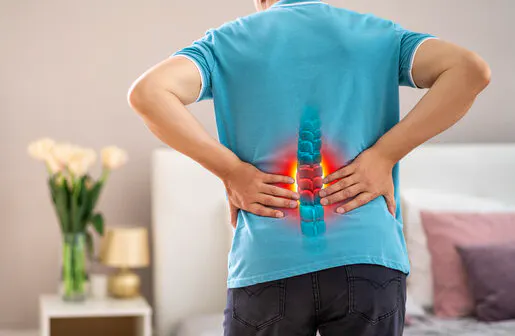
What Is a Disc Injury?
The intervertebral discs sit between each vertebra and act as shock absorbers for the spine.
Each disc has a tough outer ring, called the annulus fibrosus, and a gel-like centre, called the nucleus pulposus. A disc injury occurs when the outer ring weakens or tears, allowing the inner material to bulge or herniate outward.
This can press on nearby nerve roots or the spinal cord, causing pain, tingling, numbness, or weakness.
Disc injuries are most common in the lumbar spine and cervical spine. They may follow a sudden load, twisting injury, repetitive lifting, or develop gradually without one clear trigger.
Types of Disc Injury
A disc bulge occurs when the outer ring weakens and the disc extends beyond its normal border but remains intact.
A herniation occurs when the inner material breaks through the outer ring and may compress a nerve root.
A prolapse is a severe herniation where material from the disc nucleus protrudes significantly. These terms are sometimes used interchangeably in clinical practice.
Symptoms
Local back or neck pain is common, but referred or radicular symptoms into the limbs are a hallmark of many disc injuries.
- Local pain in the lower back or neck
- Lumbar symptoms travelling into the buttock, thigh, calf, or foot
- Cervical symptoms travelling into the shoulder, arm, or hand
- Burning, electric sensations, numbness, or weakness in the affected area
- Symptoms that worsen with prolonged sitting or bending forward
- Increased pain with coughing or sneezing
What the Research Shows
Research supports conservative care as an appropriate first-line approach for many disc-related pain presentations.
- Paige et al. (2017) , published in JAMA, reviewed 26 randomised trials and found moderate-quality evidence that spinal manipulative therapy produces meaningful improvements in pain and function for acute low back pain, including many disc-related presentations.
- A prospective randomised trial by McMorland et al. (2010) compared spinal manipulation with microdiskectomy in patients with confirmed disc herniation and sciatica who had not responded to other conservative care.
- A meaningful proportion of patients in the manipulation group improved to a comparable degree as the surgical group, supporting the value of conservative chiropractic care as a first-line approach.
- The systematic review by Brinjikji et al. (2015) found disc herniations and protrusions on imaging in a considerable proportion of pain-free adults.
- This highlights that imaging findings should be interpreted alongside the clinical presentation rather than in isolation.
How Chiropractic Care Can Help
We assess disc injuries carefully before treatment begins. The approach depends on the location and severity of the injury, the structures affected, and the nature of your symptoms.
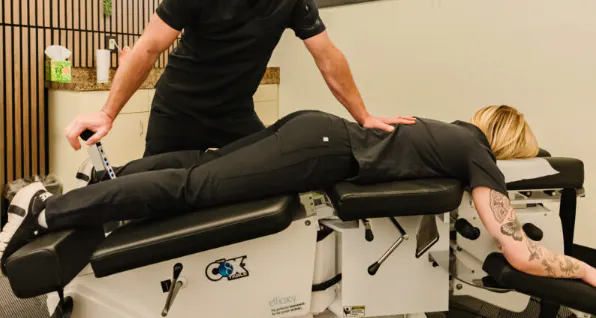
This is one of our primary approaches for lumbar disc injuries. A specialised table uses gentle rhythmic movements to create a pumping action that helps decompress the affected disc and reduce nerve-root pressure.
It avoids the loading and rotational forces used in traditional manipulation.
Muscle spasm and guarding around an injured disc can perpetuate pain and restrict recovery. Targeted soft tissue work addresses these secondary contributors.
Fine needles may be placed into tight muscles to reduce pain and improve blood flow to the affected area, particularly during the acute and subacute stages.
Progressive rehabilitation is central to disc-injury recovery. We focus on improving core stability, gradually restoring movement, and building the strength that helps prevent re-injury.
Cold laser therapy may help reduce inflammation in the area of a disc injury and support tissue recovery.
Learn more about Cold Laser Therapy or visit Cold Laser Perth .
When to See a Doctor First
Please seek urgent medical assessment before chiropractic care if you have any of the following symptoms:
- Progressive leg weakness
- Numbness in the groin or saddle area
- Changes to bladder or bowel control
These signs may indicate significant nerve compromise and require investigation before chiropractic care begins.
Understand Your Disc-Injury Treatment Options
We work with patients from Joondalup, Currambine, Woodvale, Kingsley, Duncraig, Wanneroo, and the surrounding northern suburbs.
If you are dealing with back pain, sciatica, or arm symptoms from a suspected disc injury, we can help you understand your options and what a conservative management plan looks like.
Disclaimer: This page provides general health information only and is not a substitute for professional assessment, diagnosis, or treatment. Results vary between individuals. Please consult a qualified health professional to discuss your individual circumstances.
References
- Paige NM, et al. Association of spinal manipulative therapy with clinical benefit and harm for acute low back pain: systematic review and meta-analysis. JAMA. 2017;317(14):1451-1460. PMID 28399251
- McMorland G, et al. Manipulation or microdiskectomy for sciatica? A prospective randomized clinical study. J Manipulative Physiol Ther. 2010;33(8):576-584. PMID 21036279
- Brinjikji W, et al. Systematic literature review of imaging features of spinal degeneration in asymptomatic populations. AJNR Am J Neuroradiol. 2015;36(4):811-816. PMID 25430861
Location Details

| Day | Hours |
|---|---|
| Sunday | 9:00 AM - 4:00 PM |
| Monday | 9:00 AM - 7:00 PM |
| Tuesday | 8:00 AM - 7:00 PM |
| Wednesday | 8:00 AM - 7:00 PM |
| Thursday | 8:00 AM - 7:00 PM |
| Friday | 8:00 AM - 7:00 PM |
| Saturday | 8:00 AM - 4:00 PM |

