
Motor Vehicle Accidents
Whiplash-type forces can irritate or injure the facet joints, particularly at C2/C3 and C5/C6.
One of the most common and underdiagnosed sources of neck pain, cervical facet syndrome responds well to the right conservative care.
Cervical facet pain can produce deep, achy neck pain, restricted movement, and referred pain into the head, shoulders, or between the shoulder blades. At Lakeside Chiropractic in Joondalup, it is something we assess and manage regularly.

Each vertebra in your neck has two pairs of small joints called facet joints, also known as zygapophyseal joints.
These joints connect each vertebra to the vertebrae above and below. They guide and limit movement, share the load through the spine, and are richly supplied with nerve endings.
That nerve supply makes facet joints capable of producing significant pain when irritated or injured.
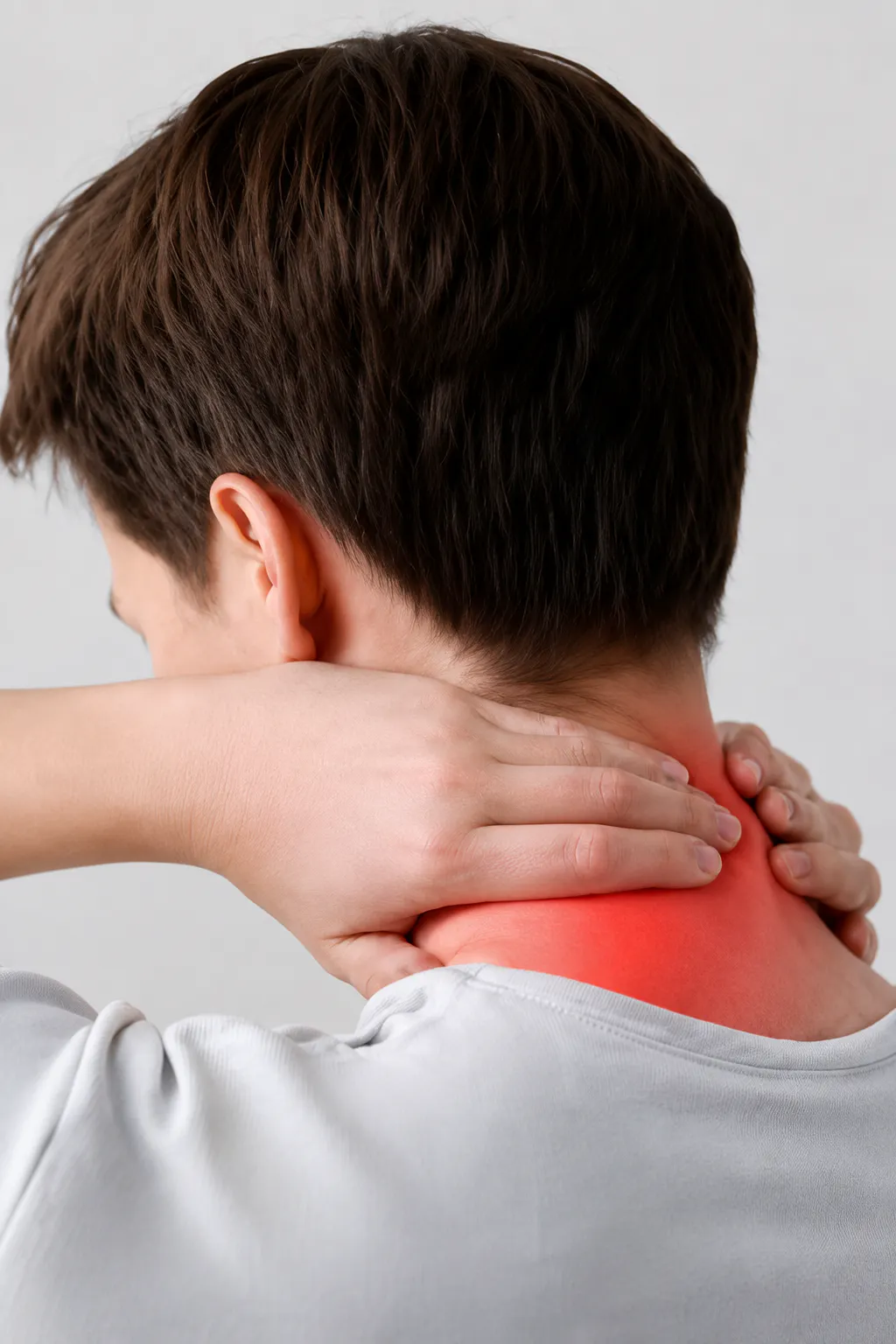
A review by Gellhorn (2011) found that cervical facet joints are implicated as a source of neck pain in a substantial proportion of patients, particularly following whiplash-type injuries.
Facet joints can become painful through sudden injury, repetitive loading, sustained posture, or gradual degeneration.
Whiplash-type forces can irritate or injure the facet joints, particularly at C2/C3 and C5/C6.
Sudden loading through the neck may affect joint movement and trigger persistent local pain.
Sustained postures and repeated loading can irritate the joints and surrounding muscles over time.
Degenerative changes can alter how the facet joints move and distribute load.
A study by Persson et al. (2016) found that around 29% of patients with chronic whiplash-associated disorders had persistent pain confirmed as originating from cervical facet joints using controlled diagnostic nerve blocks.
Facet pain is typically described as a deep, dull ache on one or both sides of the neck. It is often worse in the morning, after sustained postures, or with certain movements.
Pain is often concentrated on one side, although both sides may be involved.
Upper cervical levels may refer pain into the back of the head, ear, or jaw.
Lower cervical levels may refer pain into the shoulder, upper arm, or between the shoulder blades.
Rotation and extension are commonly limited or uncomfortable.
Symptoms may worsen when looking up, turning to one side, or sitting for long periods.
The affected level may be tender when examined directly.
Unlike disc-related pain, cervical facet pain does not usually produce tingling or numbness into the arm unless nerve-root involvement is also present.
Cervical facet pain is diagnosed primarily through clinical examination rather than imaging alone.
A prospective cohort study by Schneider et al. (2014) found that a combination of manual spinal examination, palpation for segmental tenderness, and the extension-rotation test produced a specificity of 84% for identifying facet-mediated pain.
Palpation for segmental tenderness showed a sensitivity of 94%, making it a useful screening tool in clinical practice.
Imaging such as X-ray or MRI can show facet-joint degeneration, but it does not confirm that the joints are the source of pain on its own.
The clinical picture and response to treatment remain central to the diagnosis.
We assess which levels are involved, what movements are provocative, and which treatment approach best fits your presentation.
Targeted techniques are applied to the affected cervical levels to restore movement, reduce joint irritation, and improve pain.
The Bryans et al. (2014) chiropractic guidelines issued strong recommendations for manipulation and manual therapy combined with exercise for chronic neck pain.
Hands-on release of the cervical and upper thoracic muscles helps reduce secondary muscle pain and restore more normal movement patterns.
Trigger points in the suboccipital, splenius, and levator scapulae muscles can generate referred pain that mimics the joint itself. Dry needling addresses these areas directly.
Restoring deep cervical flexor strength and endurance helps stabilise the joints and reduce repetitive loading.
Low-level laser may be applied over the affected joint levels to reduce local inflammation and pain.
Electrical stimulation is applied to the cervical region to reduce pain and muscle spasm, particularly in acute or highly irritable presentations.
Taping may be applied to the cervical and upper thoracic region to offload the joints and provide postural support.
A low-force, instrument-assisted option may be used when a gentler approach to joint treatment is more appropriate.
If you have persistent neck pain, stiffness, or referred pain into your head or shoulder that has not settled, it is worth having the facet joints properly assessed.
Many people manage facet pain for months or years without knowing what is actually causing it.
We see patients from Currambine, Woodvale, Kingsley, Duncraig, Wanneroo, Tapping, Carramar, Heathridge, Edgewater, Mullaloo, Padbury, Banksia Grove, Yanchep, Gnangara, and across Perth's northern suburbs.
Call us on 9300 0095 or book online at lakesidechiro.com.au.
Disclaimer: This page provides general health information only and is not a substitute for professional assessment, diagnosis, or treatment. Results vary between individuals. Please consult a qualified health professional to discuss your individual circumstances.

| Day | Hours |
|---|---|
| Sunday | 9:00 AM - 4:00 PM |
| Monday | 9:00 AM - 7:00 PM |
| Tuesday | 8:00 AM - 7:00 PM |
| Wednesday | 8:00 AM - 7:00 PM |
| Thursday | 8:00 AM - 7:00 PM |
| Friday | 8:00 AM - 7:00 PM |
| Saturday | 8:00 AM - 4:00 PM |

