
Sharp, Burning, or Aching Pain
Pain may travel from the neck into the shoulder, arm, forearm, or hand.
Arm pain, tingling, or weakness coming from a pinched nerve in the neck. Here is what it means and how we can help.
Cervical radiculopathy is the clinical term for symptoms that occur when a nerve root in the neck is compressed or irritated. It is one of the more disabling neck conditions we see at Lakeside Chiropractic in Joondalup, and one that may respond well to an appropriate conservative approach.

The nerves that supply your arms exit the spinal cord through small openings between the vertebrae called foramina.
When a disc herniation, bone spur, or inflamed tissue encroaches on one of these openings, the nerve root can become compressed or irritated.
The result may be pain, tingling, numbness, or weakness that travels from the neck into the shoulder, arm, or hand along the path of the affected nerve.
See our cervical disc herniation page for more detail on how disc injuries may contribute to this condition.
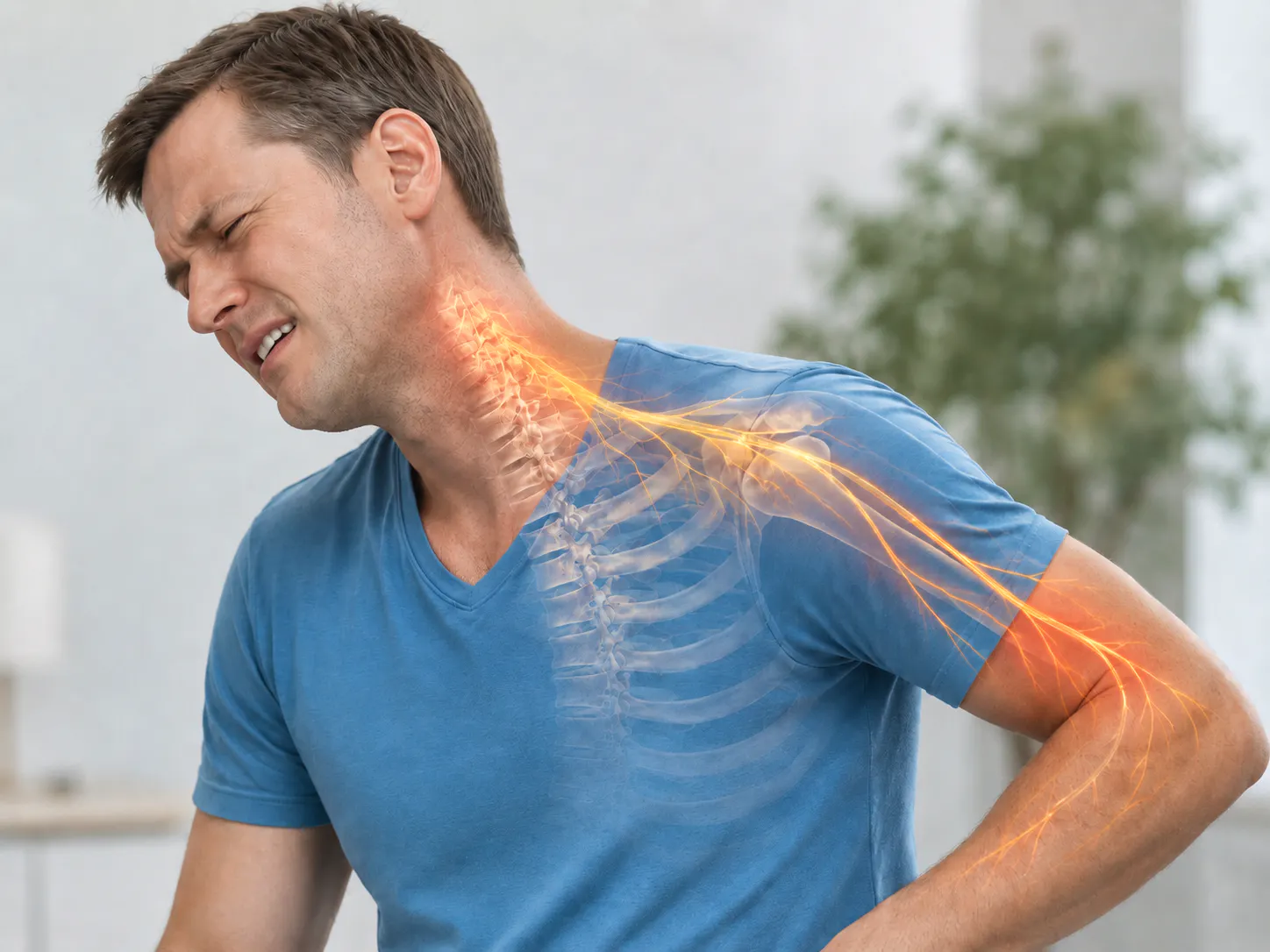
Symptoms vary with the nerve root involved and the degree of irritation. A useful distinguishing feature is that the pain, tingling, or numbness often follows a consistent path down the arm.
Pain may travel from the neck into the shoulder, arm, forearm, or hand.
Tingling often follows a specific part of the arm or enters particular fingers.
The affected nerve root may cause reduced sensation in the arm, hand, or fingers.
Weakness may affect particular muscles or grip depending on the nerve involved.
Tilting or rotating the head toward the affected side may increase symptoms.
Some people notice temporary relief when resting the hand on the head or raising the arm.
Progressive weakness or other neurological changes should not be ignored. Seek urgent medical assessment for:
These may indicate involvement of the spinal cord rather than only a nerve root.
The overall prognosis is generally favourable, and research supports an active, multimodal conservative approach for many patients.
A systematic review by Wong et al. (2014) found that most patients see substantial improvement within the first four to six months.
The majority reached complete or near-complete recovery without surgery.
A systematic review by Boyles et al. (2011) found generally promising outcomes for manual therapy used alone or alongside exercise and traction.
Improvements were reported in pain, function, and range of motion.
A review by Thoomes (2016) found that combining spinal mobilisation with motor-control exercises produced better outcomes than either approach alone and better than waiting without active care.
We need to identify which nerve root is involved, what is causing the compression, and whether there are any features that require urgent medical review.
Once we have a clear picture, we build a treatment plan around the evidence and your presentation.
Gentle techniques may be applied to the cervical and upper thoracic spine to restore movement, reduce joint compression, and offload the affected nerve root. Technique selection is adapted to the severity and nature of the presentation.
Motor-control and strengthening exercises for the cervical spine are central to recovery and relapse prevention. Exercise combined with manual therapy generally performs better than either approach alone.
Releasing the cervical, shoulder, and upper-arm musculature may reduce secondary muscle pain and improve comfort when guarding develops around an irritated nerve root.
Trigger points in the neck and shoulder muscles frequently develop alongside cervical radiculopathy and can amplify referred pain patterns.
Manual or mechanical traction creates temporary separation between the vertebrae and may reduce pressure on the nerve root in selected presentations, particularly during an acute or irritable phase.
A home-use traction device may be used to support the natural cervical curve and reduce chronic loading on an affected nerve root when appropriate.
Low-level laser may be applied to the cervical region to address local inflammation and support tissue recovery.
Read more at Cold Laser Perth.
A low-force, instrument-assisted technique may be used where a gentler approach to joint treatment is more appropriate, including acute or highly irritable presentations.
If you have arm pain, tingling, or weakness coming from your neck, it is worth getting properly assessed. The longer nerve-root compression goes unmanaged, the more established the symptoms can become.
We see patients from Currambine, Woodvale, Kingsley, Duncraig, Wanneroo, Tapping, Carramar, Heathridge, Edgewater, Mullaloo, Padbury, Banksia Grove, Yanchep, Gnangara, and across Perth's northern suburbs.
Call us on 9300 0095 or book online at lakesidechiro.com.au.
Disclaimer: This page provides general health information only and is not a substitute for professional assessment, diagnosis, or treatment. Results vary between individuals. Please consult a qualified health professional to discuss your individual circumstances.

| Day | Hours |
|---|---|
| Sunday | 9:00 AM - 4:00 PM |
| Monday | 9:00 AM - 7:00 PM |
| Tuesday | 8:00 AM - 7:00 PM |
| Wednesday | 8:00 AM - 7:00 PM |
| Thursday | 8:00 AM - 7:00 PM |
| Friday | 8:00 AM - 7:00 PM |
| Saturday | 8:00 AM - 4:00 PM |

