
Neck Pain and Stiffness
Often worse after prolonged desk work, phone use, or computer work.
Neck pain, headaches, and stiffness from screen use and forward head posture. Here is what is happening and what can help.
Tech neck and forward head posture are two names for the same underlying problem: the head has drifted forward of the shoulders, increasing the load on the cervical spine and straining the muscles, joints, and discs of the neck.

Your head weighs around 4 to 5 kilograms in a neutral position. As it moves forward, the effective load on the cervical spine rises dramatically.
Research by Hansraj (2014) found that at 15 degrees of forward tilt the load rises to around 12 kilograms. At 60 degrees, a typical phone-scrolling position, it reaches around 27 kilograms.
Over hours of daily screen use, that sustained load creates significant stress on the discs, joints, and muscles of the neck.
Over time, forward head posture can flatten the natural cervical curve, tighten muscles at the base of the skull and across the shoulders, and irritate the facet joints and discs.
For many people, occasional stiffness progresses to daily pain, headaches, and sometimes arm symptoms if a nerve becomes involved.
Often worse after prolonged desk work, phone use, or computer work.
Frequently felt at the base of the skull or across the forehead.
Tightness may build across the shoulders and shoulder blades.
Turning, bending, or extending the neck may become limited.
Changes in head and neck position can affect the muscles supporting jaw movement.
More advanced cases may involve tingling or numbness if a cervical nerve is irritated.
A randomised controlled trial by Fathollahnejad et al. (2019) found that combining manual therapy with stabilising exercises produced significantly greater improvements in neck pain, function, and forward head posture than exercise alone.
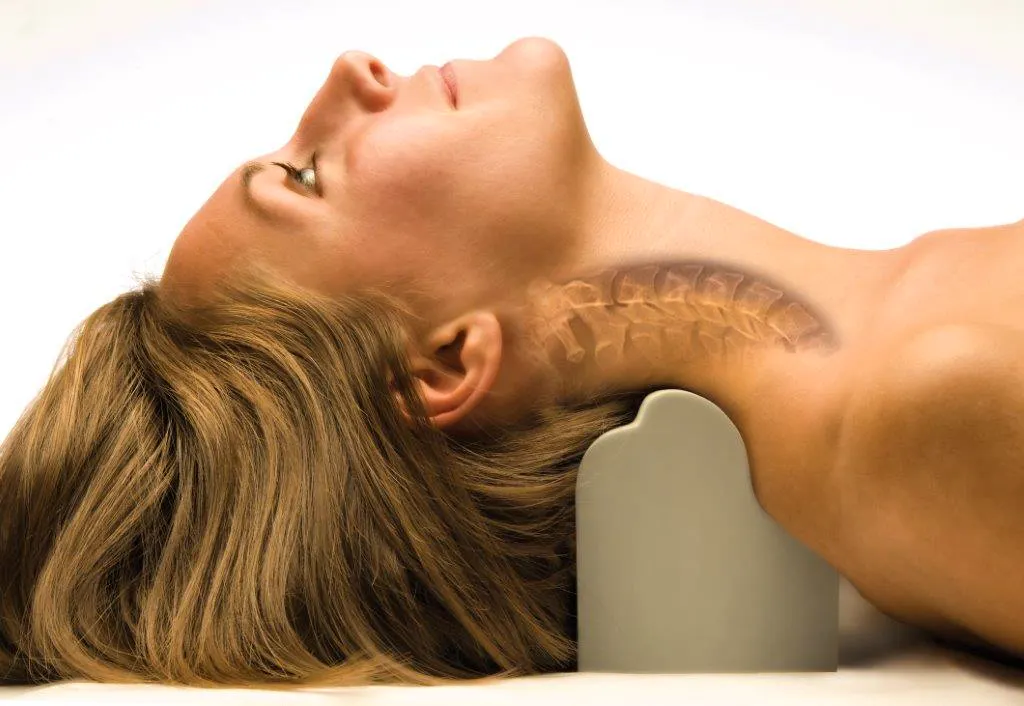
A randomised controlled trial by Suwaidi, Moustafa et al. (2023) found that Denneroll combined with corrective exercises produced greater improvements in head position than standard exercises alone, with gains maintained at three-month follow-up.
We assess how your neck is moving, where the load is sitting, what your posture looks like, and whether there is any nerve involvement.
Treatment is tailored to what your neck actually needs.
Targeted techniques to restore movement at stiff cervical and thoracic joints and reduce compressive load.
Specific strengthening for the deep neck flexors and postural muscles of the upper back.
Release of the suboccipital muscles, upper trapezius, levator scapulae, and pectoralis minor.
May be used for trigger points in the neck, upper shoulders, and base of the skull.
A home-use traction device designed to restore the natural cervical curve and correct forward head posture over time.
Low-level laser may be used to reduce inflammation in irritated cervical joints and soft tissues.
Read more at Cold Laser Perth.
Applied across the upper back and cervical region to support posture and provide feedback during the day.
Instrument-assisted soft tissue work to address fascial restrictions and chronic muscle tightness.
The most effective long-term change is adjusting how you use your devices and building the strength needed to support a better position.
Bring the screen closer to eye level instead of repeatedly dropping your head toward your chest.
Set the monitor at a height and distance that allows you to look ahead without leaning forward.
Short, frequent movement breaks reduce cumulative load from long periods in one position.
Targeted deep-neck and upper-back strengthening can improve endurance over time.
We can show you exactly what to do and how to progress it.
If your neck pain, headaches, or stiffness are starting to affect your day, it is worth getting assessed rather than waiting for it to progress.
We see patients from Currambine, Woodvale, Kingsley, Duncraig, Wanneroo, Tapping, Carramar, Heathridge, Edgewater, Mullaloo, Padbury, Banksia Grove, Yanchep, Gnangara, and across Perth's northern suburbs.
Call us on 9300 0095 or book online at lakesidechiro.com.au.
Disclaimer: This page provides general health information only and is not a substitute for professional assessment, diagnosis, or treatment. Results vary between individuals. Please consult a qualified health professional to discuss your individual circumstances.

| Day | Hours |
|---|---|
| Sunday | 9:00 AM - 4:00 PM |
| Monday | 9:00 AM - 7:00 PM |
| Tuesday | 8:00 AM - 7:00 PM |
| Wednesday | 8:00 AM - 7:00 PM |
| Thursday | 8:00 AM - 7:00 PM |
| Friday | 8:00 AM - 7:00 PM |
| Saturday | 8:00 AM - 4:00 PM |

