
Scoliosis Management in Joondalup and Perth's Northern Suburbs
A sideways curve in the spine can cause pain, postural changes, and reduced function. Chiropractic care can help manage symptoms, though current research has not established it as a structural treatment for the curve itself.
What Is Scoliosis?
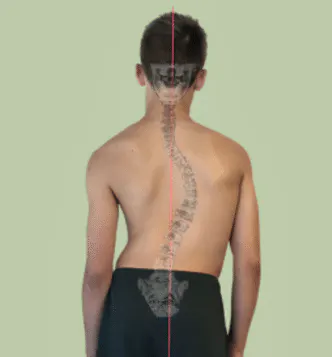
Scoliosis is a sideways curvature of the spine that, when viewed from behind, deviates from the normal straight line.
Most scoliosis is idiopathic, meaning no specific cause is identified. It can develop during childhood and adolescence as adolescent idiopathic scoliosis, or appear in adulthood, often as a result of degenerative spinal changes.
Curves are measured using the Cobb angle on X-ray. Mild curves may cause few symptoms, while larger curves can lead to visible postural asymmetry, rib prominence, and back pain.
Chiropractic Care Is Not an Established Structural Treatment
Current research has not established that chiropractic manipulation can reliably correct or permanently reduce a structural scoliotic curve in either adults or children.
A small number of preliminary studies in growing adolescents have reported modest reductions in Cobb angle, but this evidence is limited to small, uncontrolled trials and case reports and does not yet support that claim with confidence.
Chiropractic care may help reduce pain, improve spinal mobility, and support function in people living with scoliosis. If curve progression is a concern, particularly in growing children and adolescents, assessment and monitoring by an orthopaedic specialist is appropriate.
Symptoms
Many people with mild to moderate scoliosis experience no symptoms at all.
- Back pain
- Muscle fatigue and tightness, often more pronounced on one side
- Reduced range of motion
- Visible shoulder or hip asymmetry
- Breathing difficulties in severe cases
- In adults with degenerative scoliosis, possible symptoms related to spinal stenosis or nerve compression
Understanding the Cobb Angle
The Cobb angle measured on X-ray helps determine how a curve is monitored and when specialist input is appropriate.
Where imaging is needed, Lakeside Chiropractic refers for an X-ray using EOS imaging at SKG Radiology. This provides an accurate, low-dose measurement and is particularly well suited to growing children who may need repeat imaging over time.
Generally monitored, often with periodic review rather than active intervention.
Usually referred for specialist assessment, where bracing may be considered.
Typically warrants a surgical opinion, particularly while growth remains.
Checking for Scoliosis at Home
A simple first step is the Adam's forward bend test.
Ask your child to bend forward at the waist with feet together, knees straight, and arms hanging loosely. Look at their back from behind and from the side.
Watch for one side of the rib cage or back sitting higher than the other, or any obvious unevenness along the spine.
Kuznia et al. (2020) note that this test has good sensitivity for detecting curves of 20 degrees or more, although a positive result still needs to be confirmed clinically rather than relied on alone.
If you notice any asymmetry or you are simply unsure, you can book a free spinal scan for kids online and we can take a proper look.
The Leg Length Connection
In growing children, a leg length discrepancy can create a functional scoliotic curve through pelvic tilt.
This is a different mechanism from structural or idiopathic scoliosis.
Raczkowski et al. (2010) followed 369 children with leg-length-discrepancy-related functional scoliosis and found that correcting the discrepancy with a shoe or heel lift resolved the curve in the large majority of cases within a few months.
Where a growing child has both a leg length difference and a postural curve, addressing the leg length is often central to management. Read more in our leg length discrepancy article .
What the Research Shows
Current evidence supports scoliosis-specific exercise and bracing for the curve itself, while manual care may help pain and function.
- The 2016 SOSORT guidelines, published by Negrini et al. (2018) , represent international consensus on conservative management of idiopathic scoliosis. The guidelines support physiotherapeutic scoliosis-specific exercises and bracing as the primary evidence-based conservative approaches, particularly during growth.
- A 2022 meta-analysis by Ren et al. (2022) reviewed manual therapy, specifically Tuina, for idiopathic scoliosis and found benefits for pain, disability, and psychological wellbeing, particularly when manual therapy was combined with other conservative approaches.
- A 2017 systematic review by Théroux et al. (2017) identified four prospective studies suggesting spinal manipulative therapy might help prevent curve progression or reduce Cobb angle in some patients. Because the underlying studies were small and mostly uncontrolled, this remains preliminary evidence rather than an established finding.
How Chiropractic Care Can Help
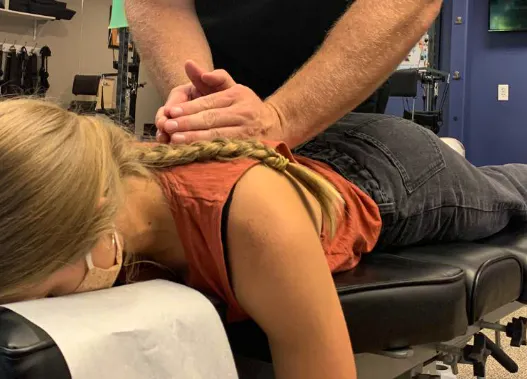
At Lakeside Chiropractic in Joondalup, we work with patients who have scoliosis to manage symptoms and maintain function.
Care is focused on pain, mobility, muscle tension, exercise, and function rather than claiming to structurally correct the curve.
The muscles on the concave side of a scoliotic curve are often chronically contracted and painful. Regular soft tissue work can provide significant relief from this pattern.
Trigger points in the paraspinal and thoracic muscles are common in people with scoliosis. Dry needling can reduce pain and improve symmetry of muscle tension.
Exercise programs tailored to the individual's curve pattern can help strengthen supporting muscles and improve postural awareness, and are one of the most valuable parts of long-term scoliosis management.
Cold laser can help address inflammation and muscle soreness associated with scoliosis-related pain.
Learn more about Cold Laser Therapy or visit Cold Laser Perth .
When to See Other Specialists
Anyone with a diagnosed curve should have it periodically monitored, particularly if growth is still occurring.
We are happy to work alongside your GP, paediatrician, or orthopaedic specialist and can provide co-management support as part of your overall care team.
Growing Children Need Ongoing Monitoring
Curve progression during growth may change whether observation, bracing, or specialist review is appropriate.
Frequently Asked Questions
Mostly, but not entirely. The classic natural-history study by Weinstein (1983) followed patients for an average of 40 years and found that curves under about 30 degrees at skeletal maturity tended not to progress further, regardless of curve pattern.
Larger curves can continue to progress slowly into adulthood, generally at around 1 degree per year. Dunn et al. (2018) note that curves over 50 degrees are associated with a meaningfully higher risk of ongoing progression even after growth has finished.
The idea that curves simply "set" once the bones mature holds up well for smaller curves, but is not a safe assumption for larger ones.
There is no single fixed schedule. Care is tailored to the individual based on symptoms, growth stage, and how a curve is behaving on monitoring.
In practice this usually means more frequent visits during a growth spurt or symptom flare, tapering off as things stabilise.
What matters more than the exact frequency is that a growing child with a diagnosed curve stays on a regular monitoring schedule with their treating specialist alongside whatever symptom-focused care we are providing.
Because scoliosis is a structural pattern that does not go away, the muscular imbalances and stiffness that come with it tend to build back up over time without ongoing attention, particularly through growth spurts, activity changes, or periods of increased pain.
Regular care is not about correcting the curve. It is about keeping the surrounding muscles, joints, and movement patterns in the best shape they can be, which can help people with scoliosis feel and function better over time.
Scoliosis Support in Joondalup
We see patients with scoliosis from Joondalup, Currambine, Woodvale, Kingsley, Duncraig, Wanneroo, and the surrounding northern suburbs.
If back pain associated with your scoliosis is affecting your quality of life, or you would like us to take a look at a child's posture, we would be happy to discuss what we can do to help.
You can also book an appointment online .
Disclaimer: This page provides general health information only and is not a substitute for professional assessment, diagnosis, or treatment. Results vary between individuals. Please consult a qualified health professional to discuss your individual circumstances.
References
- Negrini S, et al. 2016 SOSORT guidelines: orthopaedic and rehabilitation treatment of idiopathic scoliosis during growth. Scoliosis Spinal Disord. 2018;13:3. PMID 29435499
- Ren J, et al. Benefits on pain and mental health of manual therapy for idiopathic scoliosis: a meta-analysis. Front Endocrinol. 2022;13:1038973. PMID 36568101
- Kuznia AL, Hernandez AK, Lee LU. Adolescent idiopathic scoliosis: common questions and answers. Am Fam Physician. 2020;101(1):19-23. PMID 31894928
- Dunn J, Henrikson NB, Morrison CC, Blasi PR, Nguyen M, Lin JS. Screening for Adolescent Idiopathic Scoliosis: Evidence Report and Systematic Review for the US Preventive Services Task Force. JAMA. 2018;319(2):173-187. PMID 29318283
- Weinstein SL, Ponseti IV. Curve progression in idiopathic scoliosis. J Bone Joint Surg Am. 1983;65(4):447-455. PMID 6833318
- Théroux J, Stomski N, Losco CD, Khadra C, Labelle H, Le May S. Spinal Manipulative Therapy for Adolescent Idiopathic Scoliosis: A Systematic Review. J Manipulative Physiol Ther. 2017;40(6):452-458. PMID 28822477
- Raczkowski JW, Daniszewska B, Zolynski K. Functional scoliosis caused by leg length discrepancy. Arch Med Sci. 2010;6(3):393-398. PMID 22371777
Location Details

| Day | Hours |
|---|---|
| Sunday | 9:00 AM - 4:00 PM |
| Monday | 9:00 AM - 7:00 PM |
| Tuesday | 8:00 AM - 7:00 PM |
| Wednesday | 8:00 AM - 7:00 PM |
| Thursday | 8:00 AM - 7:00 PM |
| Friday | 8:00 AM - 7:00 PM |
| Saturday | 8:00 AM - 4:00 PM |

