
Lumbar Spinal Stenosis Treatment in Joondalup and Perth's Northern Suburbs
A narrowing of the spinal canal can cause leg pain and heaviness that builds the longer you walk or stand. Targeted conservative care helps most people stay active.
What Is Lumbar Spinal Stenosis?
Lumbar spinal stenosis is a narrowing of the spinal canal or the openings where nerve roots exit the spine, most often in the lower back.
It usually develops gradually as a result of degenerative changes, including disc height loss, facet-joint thickening, and ligament thickening. Together, these changes reduce the space available for the nerves.
Because it is a degenerative process, lumbar spinal stenosis becomes more common with age. It can also affect younger adults with a naturally narrower canal or a history of significant disc or joint changes.
The condition can affect one level of the spine or several, and the degree of narrowing does not always match the severity of symptoms. Some people live with imaging evidence of stenosis for years before symptoms become noticeable.

Why Leaning Forward May Feel Better
An upright or extended posture narrows the spinal canal further, while a flexed, forward-leaning posture opens it. This is why many people find that leaning over a shopping trolley or sitting provides relief.
Symptoms
The classic symptom pattern is neurogenic claudication: leg symptoms that build with walking or standing and settle with sitting or leaning forward.
- Leg pain, heaviness, cramping, or numbness that builds with walking or standing
- Symptoms that ease with sitting or leaning forward
- Symptoms that are often worse walking downhill than uphill
- Lower-back pain and stiffness
- Symptoms affecting one leg or both legs
What the Research Shows
Research supports structured conservative care that combines manual therapy, exercise, education, and progressive walking.
- Whitman et al. (2006) , published in Spine, conducted a multicentre randomised trial comparing manual physical therapy, exercise, and body-weight-supported treadmill walking with a flexion-exercise and walking program alone.
- The manual-therapy and exercise group showed significantly greater rates of perceived recovery at six weeks, with better outcomes maintained at one year.
- According to PubMed, Jensen et al. (2025) , published in Pilot and Feasibility Studies, tested a structured conservative program delivered in Danish chiropractic clinics that combined patient education, manual therapy, and a progressive home-exercise program.
- Participants improved their walking distance by an average of 45% at six weeks and 53% at twelve weeks. Clinically relevant improvements were also reported in leg pain, back pain, and physical function.
How Chiropractic Care Can Help
We manage lumbar spinal stenosis with an emphasis on positions and techniques that create space in the canal, combined with a structured and progressive exercise program.
The goal is to improve walking tolerance and daily function over time while helping you remain active.
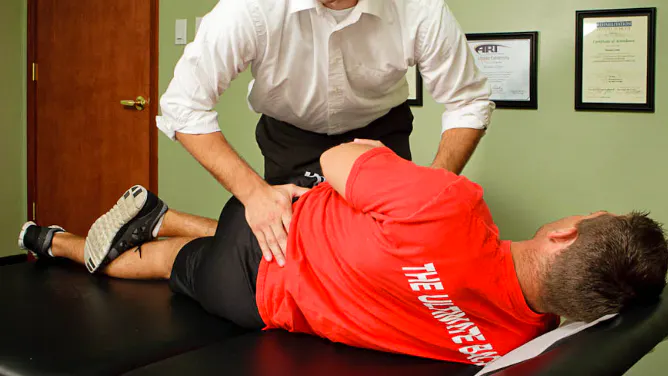
This gentle, low-load technique moves the lumbar spine into flexion on a specialised table, which is the same direction of movement known to relieve stenotic symptoms.
It is one of the best-suited techniques for this condition.
A progressive walking and strengthening program, often built around a flexion-biased posture initially, is central to improving walking distance and daily function.
The muscles supporting a stiff, guarded lumbar spine often become tight and fatigued. Hands-on treatment helps reduce this secondary muscular contribution to pain.
Cold laser therapy may help reduce inflammation around irritated nerve tissue and supporting structures.
Learn more about Cold Laser Therapy or visit Cold Laser Perth .
What to Expect
We take a full history and assessment, including your walking tolerance and the specific postures or activities that aggravate your symptoms.
Because symptoms typically progress slowly, most people manage well with conservative care for an extended period.
If walking distance and leg symptoms have been limiting your activity, we can help you build a plan to stay mobile.
Serving Perth's Northern Suburbs
We see patients from Joondalup, Currambine, Woodvale, Kingsley, Duncraig, Wanneroo, and the surrounding northern suburbs.
When Urgent Medical Assessment Is Needed
If you have significant or progressive weakness, or symptoms affecting both legs together with changes in bladder or bowel function, we will refer you for urgent medical assessment.
These signs are not appropriate for chiropractic management alone.
Disclaimer: This page provides general health information only and is not a substitute for professional assessment, diagnosis, or treatment. Results vary between individuals. Please consult a qualified health professional to discuss your individual circumstances.
References
- Whitman JM, et al. A comparison between two physical therapy treatment programs for patients with lumbar spinal stenosis: a randomized clinical trial. Spine (Phila Pa 1976). 2006;31(22):2541-2549. PMID 17047542
- Jensen RK, et al. The Boot Camp treatment program for patients with lumbar spinal stenosis in Danish chiropractic care: a feasibility study. Pilot Feasibility Stud. 2025;11(1):107. PMID 40739584
Location Details

| Day | Hours |
|---|---|
| Sunday | 9:00 AM - 4:00 PM |
| Monday | 9:00 AM - 7:00 PM |
| Tuesday | 8:00 AM - 7:00 PM |
| Wednesday | 8:00 AM - 7:00 PM |
| Thursday | 8:00 AM - 7:00 PM |
| Friday | 8:00 AM - 7:00 PM |
| Saturday | 8:00 AM - 4:00 PM |

