
Spondylolisthesis Treatment in Joondalup and Perth's Northern Suburbs
When one vertebra slips forward on the one below it, it can cause persistent lower back pain and sometimes leg symptoms. Conservative care manages most cases effectively.
What Is Spondylolisthesis?
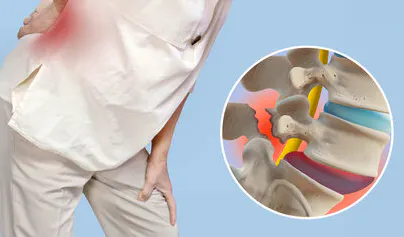
Spondylolisthesis occurs when one vertebra slides forward relative to the vertebra below it.
The degree of slip is graded from mild, Grade 1, through to severe, Grade 4. The most common location is the lower lumbar spine, particularly at L4-L5 or L5-S1.
There are several types. Degenerative spondylolisthesis is the most common form seen in adults and develops as the disc and facet joints age and can no longer hold the vertebrae in alignment.
Isthmic spondylolisthesis results from a stress fracture of the pars interarticularis, a small bone bridge in the vertebra, and is more common in younger adults and athletes who perform repeated lumbar extension.
The Grade of the Slip Helps Guide Care
Lower-grade spondylolisthesis is often managed conservatively. Higher-grade slips, significant neurological symptoms, or more complex presentations may require modified care and coordination with a GP or specialist.
Symptoms
Many people with mild spondylolisthesis have no symptoms at all, particularly in the early stages.
- Lower back pain and stiffness
- Symptoms that may worsen with activity
- Radiating ache into the buttock or legs
- Neurological symptoms if nearby nerves are compressed
- In more significant cases, a visible or palpable step deformity in the lower back
What the Research Shows
Evidence supports lumbar stabilisation and active management as first-line conservative strategies.
- A 2024 systematic review and meta-analysis by Lin et al. (2024) , published in Spine, evaluated lumbar segmental stabilisation exercises for patients with spondylolysis and spondylolisthesis across five randomised controlled trials.
- The review found that stabilisation exercises, particularly when used as a primary treatment, showed meaningful improvements in disability. The findings support exercise-based management as a first-line conservative approach.
- Foster et al. (2018) emphasised that for persistent spinal conditions, including those arising from structural changes, the evidence consistently supports active management, exercise, and self-management strategies over passive and invasive approaches.
How Chiropractic Care Can Help
At Lakeside Chiropractic in Joondalup, we manage spondylolisthesis conservatively with a focus on reducing pain, improving muscular support around the unstable segment, and helping you stay as active as possible.
Our approach is guided by the grade of your slip and your specific symptoms.
Lumbar stabilisation exercises are central to managing spondylolisthesis. Strengthening the deep core muscles that support the lumbar spine reduces the load on the unstable segment and helps prevent symptom flare-ups.
This is one of the most evidence-supported components of conservative care.
The muscles surrounding an unstable lumbar segment frequently become tight and fatigued. Soft tissue work relieves this tension and can significantly reduce pain, particularly during flare-ups.
This low-load, gentle technique can be used to improve disc mechanics and reduce nerve root irritation without applying significant compression or rotation to the affected vertebral segment.
Trigger points and muscle spasm in the lumbar and gluteal region are common with spondylolisthesis. Dry needling addresses these pain sources directly.
Cold laser therapy can help reduce inflammation around the affected vertebral segment and support tissue health.
Learn more about Cold Laser Therapy or visit Cold Laser Perth .
What to Expect
We always begin with a thorough assessment that considers your imaging, symptom history, and functional limitations.
If you have imaging confirming your spondylolisthesis, please bring it with you.
For higher-grade slips or presentations with significant neurological features, we work in conjunction with your GP or specialist to ensure an appropriate and coordinated approach.
If lower back pain and instability are making your daily life more difficult, we would be glad to help.
Serving Perth's Northern Suburbs
We see patients from Joondalup, Currambine, Woodvale, Kingsley, Duncraig, Wanneroo, and the surrounding northern suburbs.
Disclaimer: This page provides general health information only and is not a substitute for professional assessment, diagnosis, or treatment. Results vary between individuals. Please consult a qualified health professional to discuss your individual circumstances.
References
- Lin LH, et al. Effectiveness of lumbar segmental stabilization exercises in managing disability and pain intensity among patients with lumbar spondylolysis and spondylolisthesis: a systematic review and meta-analysis. Spine. 2024;49(21):1512-1520. PMID 38514931
- Foster NE, et al. Prevention and treatment of low back pain: evidence, challenges, and promising directions. Lancet. 2018;391(10137):2368-2383. PMID 29573872
Location Details

| Day | Hours |
|---|---|
| Sunday | 9:00 AM - 4:00 PM |
| Monday | 9:00 AM - 7:00 PM |
| Tuesday | 8:00 AM - 7:00 PM |
| Wednesday | 8:00 AM - 7:00 PM |
| Thursday | 8:00 AM - 7:00 PM |
| Friday | 8:00 AM - 7:00 PM |
| Saturday | 8:00 AM - 4:00 PM |

