
Spinal Degeneration Treatment in Joondalup and Perth's Northern Suburbs
Being told your spine is degenerating sounds alarming, but degenerative changes are a normal part of ageing and, with the right approach, many people maintain an active and comfortable life.

What Is Spinal Degeneration?
Spinal degeneration is the broad, umbrella term for the age-related structural changes that occur throughout the spine over time.
It covers everything from disc height and water content loss to facet joint wear, also called spinal arthritis, and the bony changes seen on an X-ray or MRI report.
If your scan mentions disc desiccation, disc bulge, facet arthropathy, or general wear and tear, this is the category those findings fall under.
These changes are extremely common and are also extremely common in people with no pain at all. Research has consistently shown that degenerative spinal changes and pain levels do not always correlate.
If your main issue is joint stiffness and aching that eases with movement, our Spinal Arthritis page covers that specific presentation in more detail.
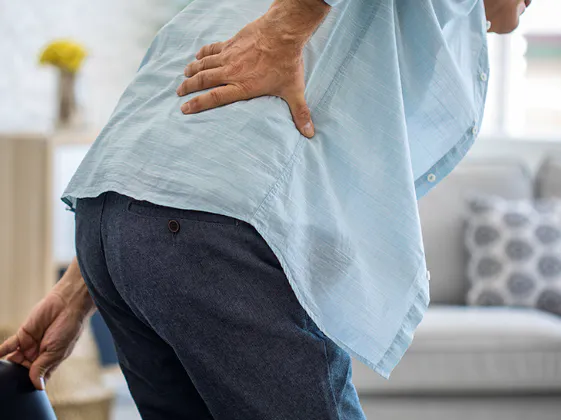
Degenerative Findings Do Not Automatically Mean Ongoing Pain
Scan findings need to be interpreted alongside your symptoms, movement, function, and clinical examination. Significant degenerative changes can appear on imaging in people who have very little or no pain.
Symptoms
Spinal degeneration can produce pain and stiffness, but some people have extensive imaging changes with very few symptoms.
- Deep, aching low back or neck pain
- Morning stiffness that eases with movement
- Gradual reduction in flexibility over time
- Referred pain into the buttocks or legs
- Nerve-related symptoms if disc or joint changes press on nearby nerves
- Significant degenerative changes on imaging with few or no symptoms in some people
What the Research Shows
Research consistently reinforces the importance of interpreting imaging carefully and prioritising movement, exercise, and self-management.
- Brinjikji et al. (2015) conducted a systematic review showing that degenerative disc changes are visible on MRI in a large proportion of people with no back pain whatsoever, and that these findings become even more common as people age.
- Disc degeneration, for example, was identified in the majority of adults over 60 who reported no symptoms. This does not mean the findings are irrelevant, but it does mean that a scan result needs to be understood in the context of each individual.
- Hartvigsen et al. (2018) identified low back pain, including that associated with spinal degeneration, as the leading cause of disability globally.
- They emphasised that staying active and avoiding over-medicalisation of degenerative findings are key principles of good management.
- Foster et al. (2018) recommended a biopsychosocial approach to persistent spinal conditions, prioritising movement, exercise, and self-management strategies over passive interventions and imaging.
How Chiropractic Care Can Help
At Lakeside Chiropractic, we help patients with spinal degeneration move more freely and manage their symptoms practically.
Our approach focuses on improving joint movement and muscular support while helping you understand what your imaging actually means for day-to-day life.
A gentle, low-load approach that rhythmically decompresses the lumbar spine. This is particularly useful where disc height loss or facet changes make firmer techniques less comfortable.
The muscles surrounding degenerative segments often carry extra load and become tight and tender. Hands-on soft tissue work addresses these compensatory patterns.
Exercise is one of the most supported strategies for managing spinal degeneration. We build individualised programs that improve core stability, flexibility, and confidence to stay active.
Dry needling is used to release trigger points and tight muscles that contribute to pain and restricted movement in people with degenerative spinal changes.
Cold laser may help reduce localised inflammation around degenerated disc and joint structures.
Learn more about Cold Laser Therapy or visit Cold Laser Perth .
Working With Your Diagnosis
If you have been told you have degenerative changes in your spine, it is worth knowing that this does not mean your pain will inevitably get worse or that your options are limited.
Many people live well with significant degenerative changes, particularly when they stay active and get appropriate support for the symptomatic periods.
If you have questions about what your imaging means for your health, we are happy to talk it through.
Serving Perth's Northern Suburbs
We see patients from across Joondalup, Currambine, Woodvale, Kingsley, Duncraig, Wanneroo, and the surrounding northern suburbs.
Disclaimer: This page provides general health information only and is not a substitute for professional assessment, diagnosis, or treatment. Results vary between individuals. Please consult a qualified health professional to discuss your individual circumstances.
References
- Brinjikji W, et al. Systematic literature review of imaging features of spinal degeneration in asymptomatic populations. AJNR Am J Neuroradiol. 2015;36(4):811-816. PMID 25430861
- Hartvigsen J, et al. What low back pain is and why we need to pay attention. Lancet. 2018;391(10137):2356-2367. PMID 29573870
- Foster NE, et al. Prevention and treatment of low back pain: evidence, challenges, and promising directions. Lancet. 2018;391(10137):2368-2383. PMID 29573872
Location Details

| Day | Hours |
|---|---|
| Sunday | 9:00 AM - 4:00 PM |
| Monday | 9:00 AM - 7:00 PM |
| Tuesday | 8:00 AM - 7:00 PM |
| Wednesday | 8:00 AM - 7:00 PM |
| Thursday | 8:00 AM - 7:00 PM |
| Friday | 8:00 AM - 7:00 PM |
| Saturday | 8:00 AM - 4:00 PM |

