
ObusForme Lowback Backrest Support — Medium
Award-winning S-shaped ergonomic backrest with removable lumbar pad — for office, home, and car use.
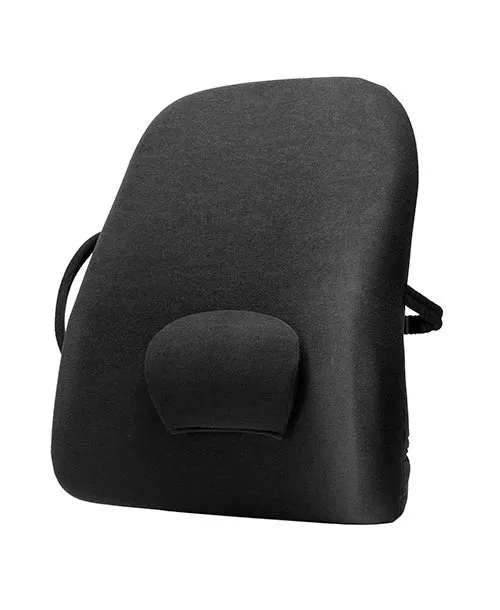
An S-shaped backrest for office, home, and car use
The ObusForme Lowback Backrest Support is an award-winning ergonomic seat backrest manufactured by ObusForme, a brand within the HoMedics wellness group.
First developed in Canada, ObusForme has been producing spinal support products for over 40 years. Their backrest range is widely used and recommended by chiropractors, physiotherapists, and ergonomics specialists across North America and Australia.
The BB-2100 model is the original Lowback Backrest Support and features an S-shaped impact-resistant polycarbonate frame covered in polyurethane foam, a removable and repositionable lumbar pad, built-in air channels for ventilation, an adjustable elastic strap system, and a carry handle.
The cover is removable and washable. The product is available in four firmness options: Firm (grey), Medium (red), Soft (black), and Extra Soft (tan).
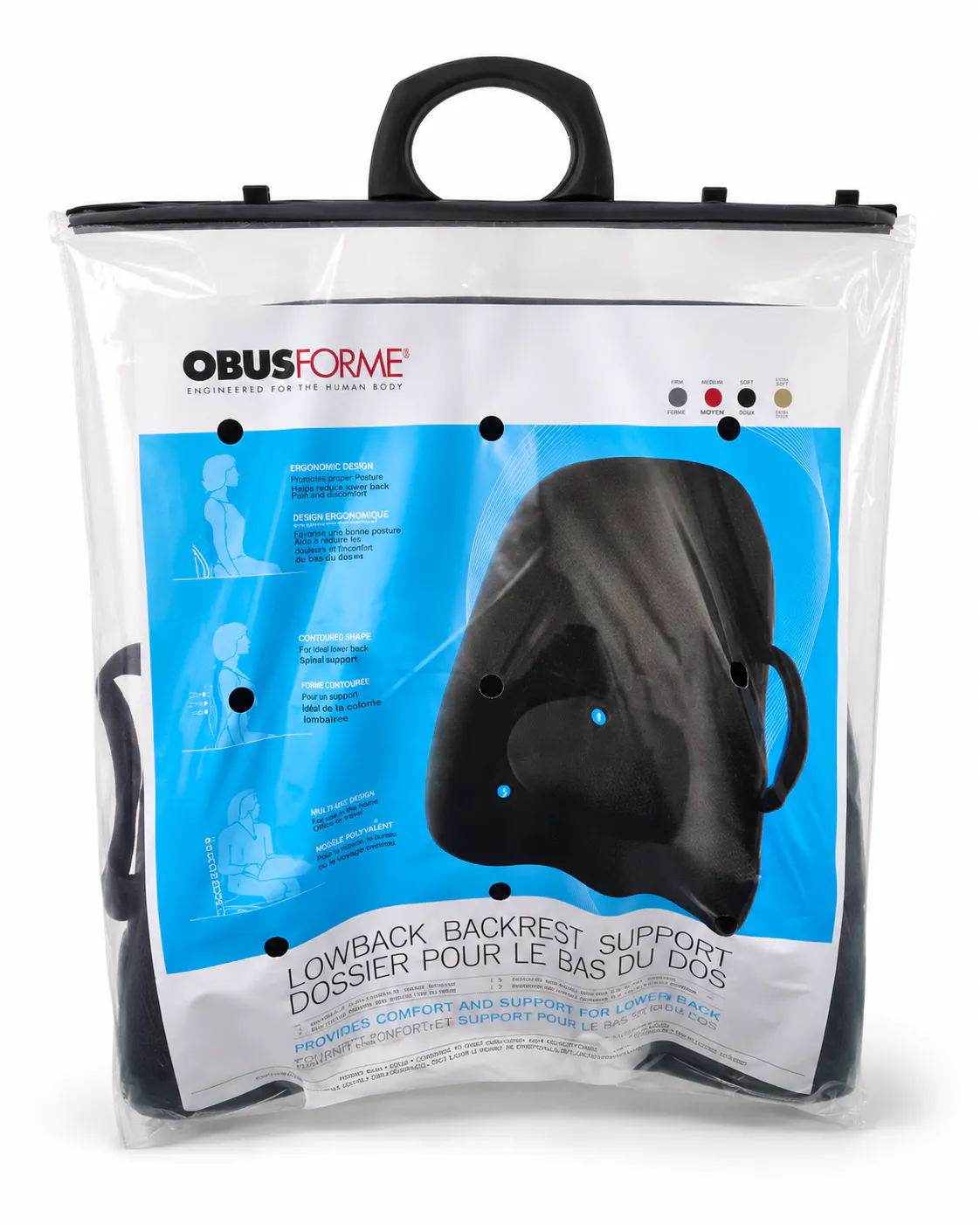
The S-shape principle
The key design feature of the ObusForme is its S-shaped frame — a fundamental departure from the traditional flat or L-shaped backrest found in most chairs.
Most standard chairs allow the pelvis to tilt backward, flattening the lumbar curve and rounding the upper back. The ObusForme's S-shaped frame actively supports the natural double curve of the spine — the lumbar lordosis at the lower back and the thoracic kyphosis at the mid and upper back — at the same time.
Targeted lower back support
The removable lumbar pad adds targeted support to the concavity of the lumbar region. It can be repositioned up or down to match your lumbar curve height, or removed entirely for a different support profile.
Full-back ergonomic support for extended sitting
S-curve support
Supports the natural S-curve of the spine through an ergonomically shaped polycarbonate frame.
Adjustable lumbar pad
Fills the lumbar concavity with support that can be repositioned or removed.
Air channels
Built-in vertical air channels reduce heat and moisture build-up during extended sitting.
Secure strap
The elastic strap attaches the backrest to most chair backs while allowing repositioning.
Portable design
Lightweight with a carry handle for office chairs, car seats, dining chairs, and travel.
Evidence and clinical context
- 35% pressure reduction claim: This figure comes from laboratory pressure-mapping tests comparing the ObusForme against standard flat foam backrests, not from a clinical trial against no support.
- Sitting posture and disc load: Spinal load research shows that flexed sitting increases compressive disc load. A supported upright seated posture helps maintain lumbar lordosis and reduce this load.
- Lumbar support and posture: Lumbar support devices can improve seated lumbar posture by reducing posterior pelvic tilt and increasing lumbar lordosis.
- Relevance to chiropractic care: For patients who sit 6 to 10 hours per day, improving seated posture can reduce the daily postural load that perpetuates back pain.
- Neck and shoulder benefit: Better lumbar alignment may reduce compensatory upper back rounding, neck strain, and shoulder tension.
- Important context: This is a passive ergonomic support. It is best used alongside active rehabilitation and postural exercises rather than as a standalone solution.
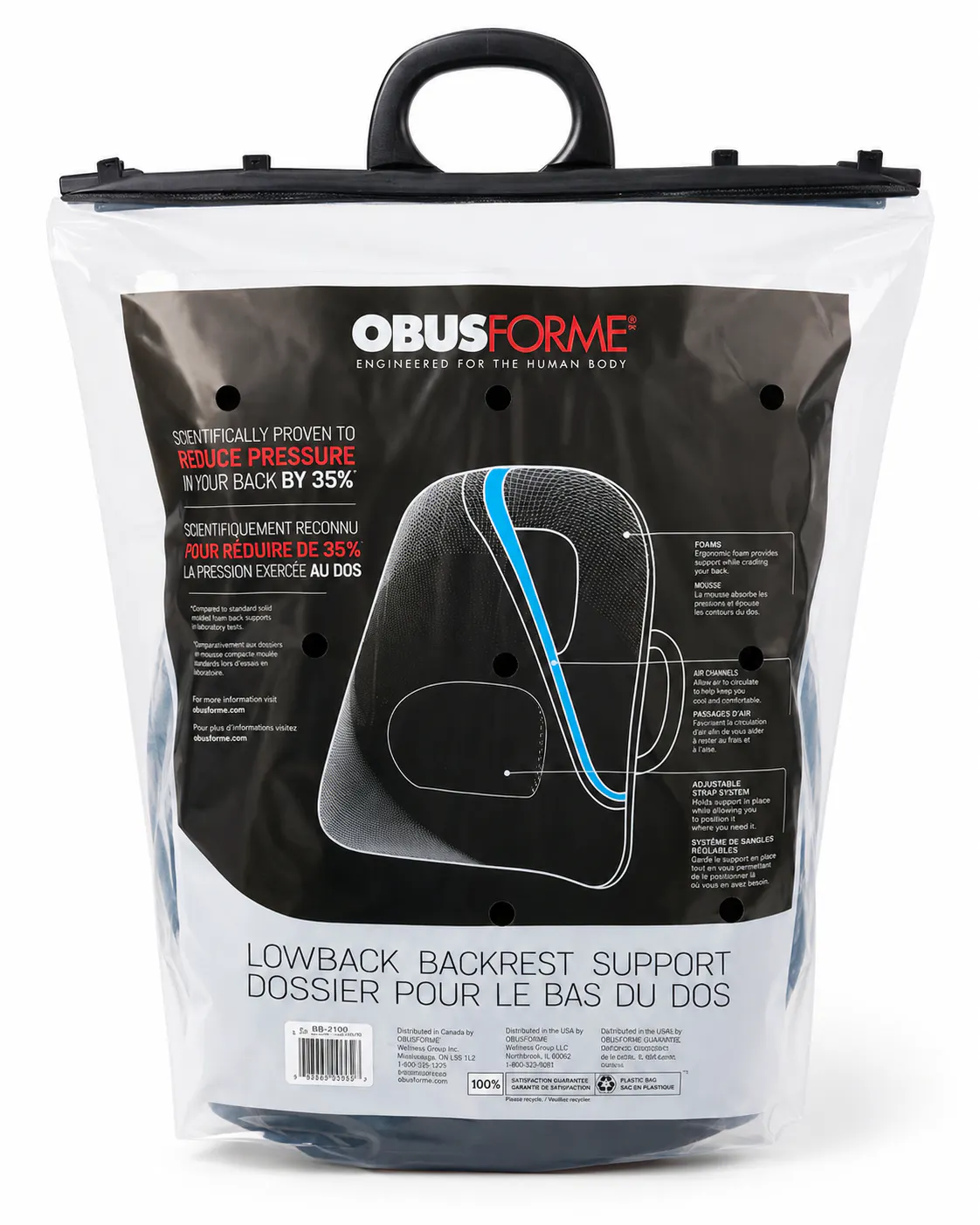
Portable, adjustable backrest support
S-shaped backrest
The shaped frame supports the lower and mid-back rather than only the lumbar curve.
Front packaging
Designed for office, home, and car seating with a strap and carry handle.
Product features
Air channels, foam support, adjustable strap, and ergonomic contouring.
Set it up so the lumbar pad meets your lower back
- Place the ObusForme against the back of your chair with the lumbar pad facing inward toward your body.
- The lumbar pad should sit at the level of your lower back — approximately at the belt line or just above.
- Thread the elastic adjustment strap around the chair back and secure it to hold the backrest in position.
- Sit fully back into the chair so your whole back is in contact with the backrest. Do not perch forward on the seat.
- If the lumbar pad feels too firm, remove it initially and reintroduce it once you have adapted to the main backrest.
- Allow an adaptation period of one to two weeks if you are used to sitting in a slumped posture.
- Use consistently across chairs where you sit for extended periods, such as your desk, dining chair, or car seat.
- Care: wipe the foam surface with a damp cloth as needed. The fabric cover is removable and washable.
Important — please read before use
- If you experience increased pain, try removing the lumbar pad and using the main backrest alone.
- If pain persists or worsens, contact your chiropractor before continuing.
- This is a passive ergonomic support. It does not replace chiropractic assessment or active rehabilitation.
- Not suitable as the sole management strategy for severe back pain, disc herniation, or acute episodes.
- Some patients require an adaptation period of one to two weeks. Sharp or radiating pain should not be ignored.

