
Shockwave Therapy for Plantar Fasciitis in Joondalup: An Option for Persistent Heel Pain

Pain with your first steps in the morning can make even a short walk uncomfortable. If heel pain keeps returning despite changes to footwear, stretching or other care, it may be time to review your treatment plan.
Lakeside Chiropractic now offers shockwave therapy in Joondalup. It may be considered for selected patients with persistent plantar fasciitis, following an assessment of the cause of their heel pain.
What is plantar fasciitis?
Plantar fasciitis affects the band of connective tissue along the sole of the foot, known as the plantar fascia. Persistent symptoms are also called plantar fasciopathy.
Typical symptoms include pain beneath the heel, particularly during the first steps after sleeping or sitting, and discomfort during standing or walking. However, heel pain can have other causes, so an assessment matters before choosing treatment.
Read more about plantar fasciitis and heel pain.
What is shockwave therapy?
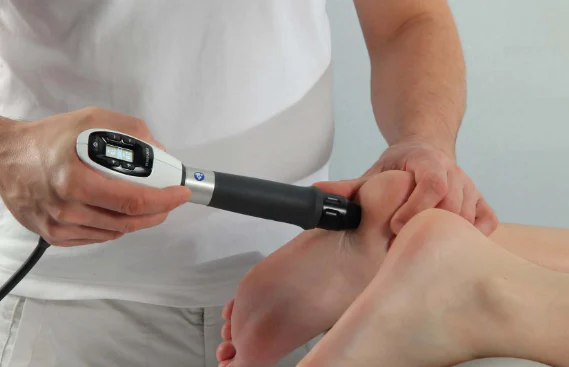
Shockwave therapy delivers repeated mechanical pressure pulses through a handheld applicator to a selected area. Radial treatment spreads these pulses across a relatively broad area, while focused shockwave uses a different technology.
At Lakeside Chiropractic, we use radial shockwave therapy. Treatment may influence pain signalling and tissue responses, although the exact mechanisms are still being investigated. It does not involve an injection or surgery.
Our shockwave therapy service page explains the treatment process and factors that may affect suitability.
What does the research say about shockwave for plantar fasciitis?
Research provides support for shockwave as an option for persistent plantar heel pain, although findings vary between studies.
A 2024 systematic review and meta-analysis by Lippi and colleagues included 11 randomised controlled trials. It reported reductions in pain with both radial and focused shockwave. The authors also found that treatment settings could influence outcomes and noted that the optimal treatment programme remains uncertain.
Evidence specifically for radial treatment includes a placebo-controlled trial involving 245 patients by Gerdesmeyer and colleagues. This study found greater improvements in pain and function with radial shockwave than placebo in patients with chronic plantar fasciitis, with benefits reported at follow-up.
A 2021 best practice guide published in the British Journal of Sports Medicine recommended starting with education, plantar fascia stretching and taping, then considering shockwave when initial care does not provide sufficient improvement.
Taken together, these findings support discussing shockwave as a treatment option for selected patients, with realistic expectations and a plan to review progress.
When might shockwave be considered?
Shockwave may be worth discussing when heel pain has persisted and initial management has not helped enough. Your chiropractor will consider your symptoms, previous care, activity demands and medical history before recommending a plan.
Not every patient with plantar fasciitis needs shockwave. Assessment also helps identify whether referral or further investigation is appropriate.
Why rehabilitation still matters
Shockwave can be one part of a broader approach. Stretching, advice about footwear and activity, and appropriately progressed exercise may also be included according to your assessment.
Our rehabilitation service can help guide an individual exercise plan and progression back to usual activities.
What does treatment feel like?
You will usually hear clicking and feel repeated tapping or pulsing over the treatment area. It can be uncomfortable over a tender heel, and the intensity can be adjusted according to your response.
Temporary soreness, redness or bruising can occur. Your clinician will discuss possible adverse effects, suitability and any recommended activity changes before treatment.
How many sessions will I need?
There is no single schedule that suits everyone. Research has used different treatment programmes, and your plan should reflect your condition and response.
Progress should be reviewed rather than assuming a fixed course will produce a particular result. Improvement may develop over time, and an immediate change after one appointment does not guarantee lasting relief.
Looking for shockwave therapy for heel pain in Joondalup?
If persistent heel pain is affecting your walking, work or exercise, Lakeside Chiropractic can assess your symptoms and discuss suitable management options.
Learn more about shockwave therapy at Lakeside Chiropractic, or book an assessment at our clinic at 3/45 Central Walk, Joondalup.
Research references
- Lippi L, et al. (2024). Efficacy and tolerability of extracorporeal shock wave therapy in patients with plantar fasciopathy: a systematic review with meta-analysis and meta-regression. European Journal of Physical and Rehabilitation Medicine, 60(5), 832–846. View research.
- Gerdesmeyer L, et al. (2008). Randomised placebo-controlled multicentre study of radial shockwave for chronic plantar fasciitis. American Journal of Sports Medicine, 36(11), 2100–2109. View research.
- Morrissey D, et al. (2021). Management of plantar heel pain: a best practice guide informed by a systematic review, expert clinical reasoning and patient values. British Journal of Sports Medicine, 55(19), 1106–1118. View research.
Latest Posts


