
Does Shockwave Therapy Actually Work? An Evidence-Based Guide for Joondalup Patients

Shockwave therapy is one of the most searched treatments for stubborn tendon pain, and one of the most misunderstood. Some people arrive expecting a miracle. Others have been told it is a gimmick. The truth sits between those two positions, and it depends heavily on what is being treated.
Short answer: shockwave therapy has reasonable evidence for some persistent tendon and fascia problems, especially plantar heel pain. It is less convincing for others. It works best as part of a plan that includes assessment, load management and exercise, not as a standalone fix.
This guide covers what the research actually shows, which conditions it may suit, who should avoid it, and what a course of treatment looks like at our Joondalup clinic.
Key points
- Strongest evidence: persistent plantar heel pain, also called plantar fasciopathy
- Reasonable but mixed evidence: Achilles, patellar and lateral elbow tendinopathy
- Usually three to five sessions, spaced about a week apart
- Not suitable for acute tears, fractures, infection or certain medical conditions
- Always preceded by an assessment, never sold as a fixed package
What shockwave therapy actually does

Shockwave therapy delivers short bursts of mechanical pressure through the skin to a targeted area. At Lakeside Chiropractic we use radial shockwave, which spreads the pressure pulses across a broader region rather than focusing them on a single point. You can read how the treatment is applied on our shockwave therapy page.
The mechanical stimulus is thought to influence pain signalling and prompt a local tissue response, including changes in blood flow and collagen remodelling. The exact biology is still being studied, which is why the evidence is best described as promising rather than settled.
It is not the same as therapeutic ultrasound, which uses high frequency sound waves. If you have compared the two, our ultrasound therapy page explains the difference.
What the research says

Evidence for shockwave varies by condition, by machine type and by treatment protocol. That is the single most important caveat in this article.
Plantar fasciopathy (persistent heel pain)
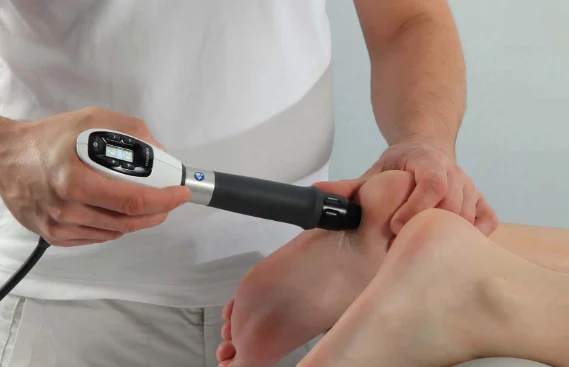
This is where the evidence is strongest. A 2024 systematic review and meta-analysis by Lippi and colleagues examined randomised trials of shockwave for plantar fasciopathy and reported reductions in pain. The authors found that treatment settings influenced results and that the optimal protocol remains uncertain [1].
An earlier randomised, placebo controlled multicentre trial by Gerdesmeyer and colleagues, which included 245 patients with chronic plantar fasciitis, found that radial shockwave produced greater improvements in pain and function than placebo [2].
A 2021 best practice guide in the British Journal of Sports Medicine recommended starting with education, plantar fascia stretching and taping, then considering shockwave when early care is not enough [3]. That sequence matters. Shockwave is generally a next step, not a first step.
We cover heel pain in more detail in our guide to shockwave therapy for plantar fasciitis and on our plantar fasciitis page.
Tendinopathy more broadly
A 2024 review by Majidi and colleagues examined 45 clinical studies across several types of tendinopathy and reported pain reductions for some conditions, while noting that more high quality research is needed [4].
A separate 2024 review by Elgendy and colleagues found that results varied by condition and that shockwave did not consistently outperform comparison treatments across all tendon types [5]. That is an honest summary of where the field sits: helpful for some people, not a universal answer.
A third 2024 review, focused on athletes and physically active people, found that shockwave may be useful for selected sports related conditions, either on its own or alongside exercise [6]. Again, the response varied by condition.
Achilles tendinopathy

Achilles problems are commonly treated with shockwave, and the broader tendinopathy reviews include them. Response tends to be gradual, and loading exercises remain central. Read more about Achilles tendinopathy.
Patellar tendinopathy (jumper's knee)

Shockwave is sometimes used for persistent patellar tendon pain, usually alongside a progressive strength plan. Our patellar tendinopathy page covers assessment and rehabilitation.
Tennis elbow (lateral elbow tendinopathy)

Lateral elbow tendinopathy is one of the more common upper limb reasons for referral. Evidence is mixed but supportive enough that shockwave is a reasonable option when other care has stalled. See our tennis elbow page.
Gluteal tendon pain

Some persistent outer hip presentations may be considered, particularly greater trochanteric pain. Our greater trochanteric pain syndrome page explains how these are assessed.
What about back pain?

Shockwave is not a standard treatment for mechanical low back pain. If back pain is your main issue, the evidence supports a different approach, starting with assessment and exercise. Our article on adjustment, exercise or both for lower back pain explains what tends to work.
Shockwave compared with other treatments
- Radial shockwave: mechanical pressure pulses, used for persistent tendon and fascia problems. Evidence varies by condition.
- Therapeutic ultrasound: high frequency sound waves, used as an adjunct for soft tissue symptoms. Limited evidence for many uses.
- Corticosteroid injection: anti-inflammatory medication for short term pain relief. Repeated use can weaken the tendon.
- Dry needling: a fine needle into trigger points for muscular pain and tension. Evidence is mixed.
- Exercise and loading: progressive strength work, the foundation of tendon rehabilitation. It takes weeks to show change.
A list like this oversimplifies, but the takeaway is fair: shockwave is one option among several, and it rarely replaces loading exercise. For a broader comparison of who does what, see our article on chiropractors versus physiotherapists.
Who shockwave may suit
You may be a reasonable candidate if:
- Your pain has lasted more than six to eight weeks
- You have a diagnosed or suspected tendon or fascia problem
- Exercise and activity changes have not been enough
- You can commit to a short course of sessions and a home plan
- You understand that improvement is usually gradual
Who should avoid it
Shockwave is not appropriate for everyone. Your clinician will screen for:
- Pregnancy, when treatment would be over the abdomen or pelvis
- Active infection, open wounds or a tumour near the area
- Recent fracture, acute muscle tear or acute injury
- Bleeding disorders or medication that affects clotting
- Implanted electronic devices near the treatment area
- Treatment over the lungs, growth plates, cartilage surfaces or sensitive spinal regions
- Reduced sensation or certain neurological conditions
This list is not complete. Suitability is decided case by case after an assessment.
What a course looks like at Lakeside
- Assessment. Your chiropractor reviews your history, examines the area, and considers whether the problem is tendon, joint, nerve or something else. Imaging is only ordered when it will change the plan.
- Consent and expectations. You are told what the evidence does and does not support, what the sessions involve, and what alternatives exist.
- Treatment sessions. A typical course is three to five sessions, usually about a week apart, though this varies with the condition and your response. Intensity is adjusted to your comfort.
- Rehabilitation. Shockwave is paired with loading exercises, activity changes or hands on care. Our rehabilitation service and soft tissue therapy are often part of the same plan.
- Review. Progress is checked rather than assumed. If you are not improving after a reasonable trial, the plan changes. Our article on how many chiropractic sessions you may need explains why fixed packages are a red flag.
Does it hurt?
Most people describe a rapid tapping or pulsing sensation, and a clicking sound from the device. Over a tender area it can be uncomfortable, particularly in the first minute. Intensity can be reduced.
Afterwards you may have temporary soreness, redness, swelling or bruising. This usually settles within a day or two. You can normally continue daily activities, though your clinician may ask you to modify heavy loading or sport for a short period.
How soon will you notice a change?
Some people notice less pain within a few days. Others need several sessions before a trend appears. Tendon tissue responds slowly, so a fair trial is usually measured in weeks, not days.
Be cautious of anyone promising a set result by a set date. A realistic goal is a clear downward trend in pain and a steady return to loading over four to eight weeks, alongside your exercise plan.
Frequently asked questions
Is shockwave therapy the same as ultrasound?
No. Shockwave therapy uses mechanical pressure pulses. Ultrasound uses high frequency sound waves. They are different treatments with different evidence.
Can I exercise after shockwave?
Often yes, but the type and volume may need adjusting for a day or two. Your rehabilitation plan should guide this.
How many sessions will I need?
There is no single number. Three to five is common, but your response and the condition determine the plan.
Is shockwave safe?
Serious adverse events are uncommon when it is used appropriately and screened for. Minor soreness and bruising are the most frequent effects.
Will my private health fund cover it?
Coverage depends on your fund and policy. Check with your insurer before booking. You can also read about HICAPS facilities for on the spot claiming.
Do I need a referral?
Usually not. You can book directly for an assessment. If your situation needs another opinion, we will say so. More general questions are answered on our FAQ page.
The bottom line
Shockwave therapy is a legitimate option for some persistent tendon and fascia problems, with the best evidence for plantar heel pain. It is not a cure for everything, and it is not a substitute for assessment, load management and exercise.
If you have a tendon problem that has not settled, the useful question is not whether shockwave works in general, but whether it is likely to help your specific issue. That is what an assessment answers.
You can read more about shockwave therapy at Lakeside Chiropractic, including how suitability is assessed and what treatment involves.
This article is general information, not individual medical advice. If you have severe pain, numbness, weakness, a recent injury or a history of spinal surgery, speak to a qualified healthcare provider about your situation.
Book an assessment at Lakeside Chiropractic
3/45 Central Walk, Joondalup WA 6027
Call 08 9300 0095 or book online.
Research references
- Lippi L, Folli A, Moalli S, Turco A, Ammendolia A, de Sire A, et al. Efficacy and tolerability of extracorporeal shock wave therapy in patients with plantar fasciopathy: a systematic review with meta-analysis and meta-regression. Eur J Phys Rehabil Med. 2024;60(5):832-46. doi:10.23736/S1973-9087.24.08136-X
- Gerdesmeyer L, Frey C, Vester J, Maier M, Weil L Jr, Weil L Sr, et al. Radial extracorporeal shock wave therapy is safe and effective in the treatment of chronic recalcitrant plantar fasciitis: results of a confirmatory randomized placebo-controlled multicenter study. Am J Sports Med. 2008;36(11):2100-9. doi:10.1177/0363546508324176
- Morrissey D, Cotchett M, Said J'Bari A, Prior T, Griffiths IB, Rathleff MS, et al. Management of plantar heel pain: a best practice guide informed by a systematic review, expert clinical reasoning and patient values. Br J Sports Med. 2021;55(19):1106-18. doi:10.1136/bjsports-2019-101970
- Majidi L, Khateri S, Nikbakht N, Moradi Y, Nikoo MR. The effect of extracorporeal shock-wave therapy on pain in patients with various tendinopathies: a systematic review and meta-analysis of randomized control trials. BMC Sports Sci Med Rehabil. 2024;16(1):93. doi:10.1186/s13102-024-00884-8
- Elgendy MH, Khalil SE, ElMeligie MM, Elazab DR. Effectiveness of extracorporeal shockwave therapy in treatment of upper and lower limb tendinopathies: a systematic review and meta-analysis. Physiother Res Int. 2024;29(1):e2042. doi:10.1002/pri.2042
- Rhim HC, Shin J, Kang J, Dyrek P, Crockett Z, Galido P, et al. Use of extracorporeal shockwave therapies for athletes and physically active individuals: a systematic review. Br J Sports Med. 2024;58(3):154-63. doi:10.1136/bjsports-2023-107567


