
Vasyli Signature Series — Trevor Prior Sports Low Profile Orthotic
Biomechanically engineered heat-mouldable sports orthotic designed for low-profile footwear — featuring 1st Ray Technology, intrinsic heel raise, extended metatarsal raise, and medial rearfoot control.
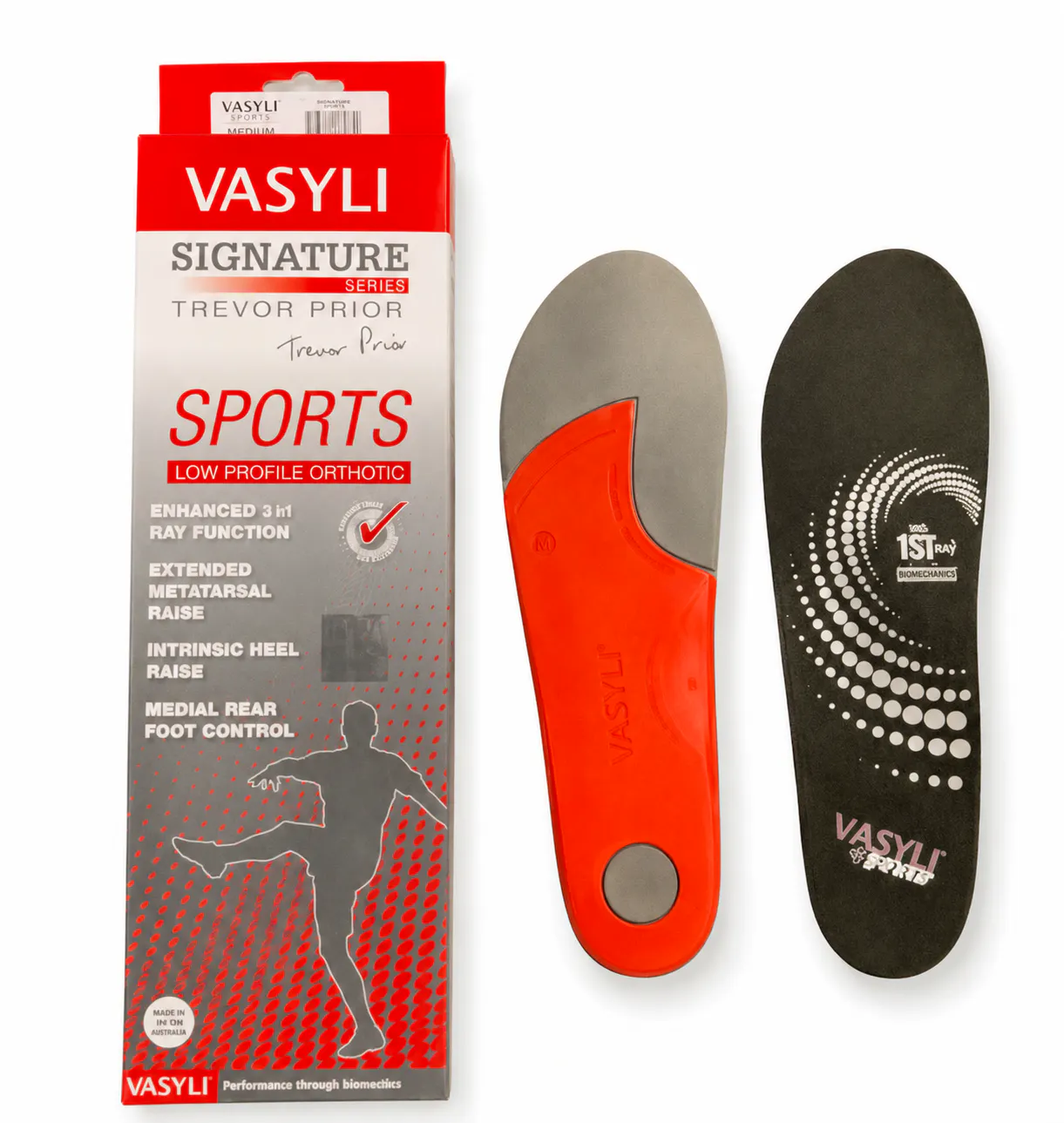
Designed for sports shoes where conventional orthotics are often too bulky
The Vasyli Signature Series Trevor Prior Sports Low Profile Orthotic is a premium heat-mouldable prefabricated orthotic designed specifically for low-profile sports footwear including athletic trainers, cleats, and sports shoes with thin insoles.
It was developed through a collaboration between Phillip Vasyli, founder of Vasyli International, and Trevor Prior, a UK-based Podiatric Surgeon and internationally recognised sports biomechanics expert.
Trevor Prior has over 25 years of clinical experience in sports injuries, biomechanics, gait analysis, and orthoses, and has worked extensively with elite and professional athletes across football, rugby, cricket, athletics, hockey, and badminton.
The orthotic profile was optimised using advanced in-shoe pressure sensor technology for the demands of sports footwear.
Biomechanical control without unnecessary bulk
Enhanced 3-in-1 First Ray Function
Vasyli's 1st Ray Plantarflexor Technology uses forefoot contouring to facilitate 1st ray plantar flexion, improving hallux dorsiflexion during push-off.
Extended Metatarsal Raise
An extended met dome support distributes pressure more evenly across the forefoot and reduces localised loading under individual metatarsal heads.
Intrinsic Rearfoot Post with 4mm Heel Raise
A 3-degree medial rearfoot post and 4mm intrinsic heel raise control excessive pronation while reducing posterior chain tension.
Medial Rearfoot Control
The medial rearfoot architecture provides control of subtalar joint pronation through shell geometry and posting rather than bulk.
Heat-Mouldable EVA Shell
High-density EVA can be heat-moulded in a clinical setting for improved arch contact, comfort, and biomechanical performance.
PU Shock Dot and Aegis Top Cover
Heel and forefoot polyurethane components help manage impact loads, while the antimicrobial top cover inhibits odour-causing bacteria.
Approximate shoe size guide
Sizing is by shoe size. The orthotic is trimmed to fit the shoe at the toe end if needed.
| Size | Approx. Shoe Size (AU/UK Women) | Approx. Shoe Size (AU/UK Men) |
|---|---|---|
| XS | 3 – 4 | — |
| S | 5 – 6 | 4 – 5 |
| M | 7 – 8 | 6 – 7 |
| L | 9 – 10 | 8 – 9 |
| XL | 11+ | 10 – 11+ |
Purpose-built support for dynamic sports activity
Controls pronation
Controls excessive subtalar pronation during dynamic sports activity through medial rearfoot posting and arch support.
Supports push-off
Facilitates 1st ray plantar flexion to improve hallux dorsiflexion during push-off.
Distributes forefoot load
The extended metatarsal raise reduces focal pressure under individual metatarsal heads.
Reduces posterior tension
The 4mm heel lift reduces Achilles and posterior chain tension.
Fits sports footwear
Designed for low-profile sports footwear where conventional orthotics are often too thick.
Common conditions with a biomechanical component
- Plantar fasciitis: Medial arch support and rearfoot control reduce plantar fascia loading during activity.
- Achilles tendinopathy: The 4mm intrinsic heel raise reduces tensile load on the Achilles tendon and calf complex.
- Patellofemoral pain syndrome: Rearfoot control may help reduce excessive pronation and associated tibial rotation.
- Iliotibial band syndrome: Rearfoot control orthotics are commonly included in management of ITB syndrome in runners and cyclists.
- Metatarsalgia and forefoot pain: The extended metatarsal raise distributes pressure more evenly across the metatarsal heads.
- 1st ray dysfunction and hallux conditions: 1st Ray Plantarflexor Technology addresses restricted 1st ray mobility.
- Low back pain and knee pain: Foot posture can affect alignment of the lower kinetic chain and rotational stresses transmitted to the knee, hip, and lumbar spine.
- Evidence context: Evidence for prefabricated orthotics in lower limb overuse injuries is moderately strong, with short-term benefits for plantar heel pain and support for patellofemoral pain.
Fit, trim, and adapt gradually
- Remove the existing factory insole from the shoe before inserting the orthotic. If the shoe cannot accommodate removal of the factory insole, the orthotic can be placed on top, but this reduces fit and may create pressure points.
- Insert with the heel of the orthotic aligned to the heel of the shoe. If the orthotic is too long at the toe end, trim carefully with scissors in small increments until it fits.
- The orthotic should feel snug against the arch without creating pressure points. If the medial arch feels too high, or if there is discomfort in the heel or forefoot, consult your chiropractor or podiatrist.
- Allow an adaptation period of 1 to 2 weeks of gradually increasing wear time. Starting with 2 to 4 hours daily and increasing over two weeks is a reasonable approach.
- Heat-moulding should be performed by a trained practitioner using a heat gun or clinical oven. Do not attempt to heat-mould at home without guidance.
- Use in sports footwear intended for the activity. Do not use in sandals, slip-ons, or footwear without an enclosed heel.
- Replace when the shell shows significant compression, the arch contour flattens, or the top cover is worn through — typically 12 to 18 months for regular sports use.
Important — please read before use
- Prefabricated orthotics address general biomechanical patterns and are not a substitute for custom-made orthotics where specific clinical measurements and casting are required.
- An adaptation period is essential. Sudden full-time wear can cause calf soreness, arch fatigue, and knee discomfort as the kinetic chain adapts.
- If you experience increased pain, knee discomfort, or new symptoms after introducing the orthotic, discontinue use and consult your chiropractor.
- This orthotic is designed for sports footwear. It is not suitable for high heels, dress shoes without adequate depth, or footwear without a removable insole.
- This product is a supportive orthotic aid. It addresses biomechanical contributing factors but does not replace chiropractic, podiatric, or physiotherapy assessment and treatment.
Product image
Signature Series Trevor Prior Sports low-profile orthotic with 1st Ray Technology and rearfoot control.

