
AllCare Progressive Resistance Tubing — 1.5m
Professional-grade colour-coded resistance tubing for rehabilitation, home exercise programs, and progressive strength training.
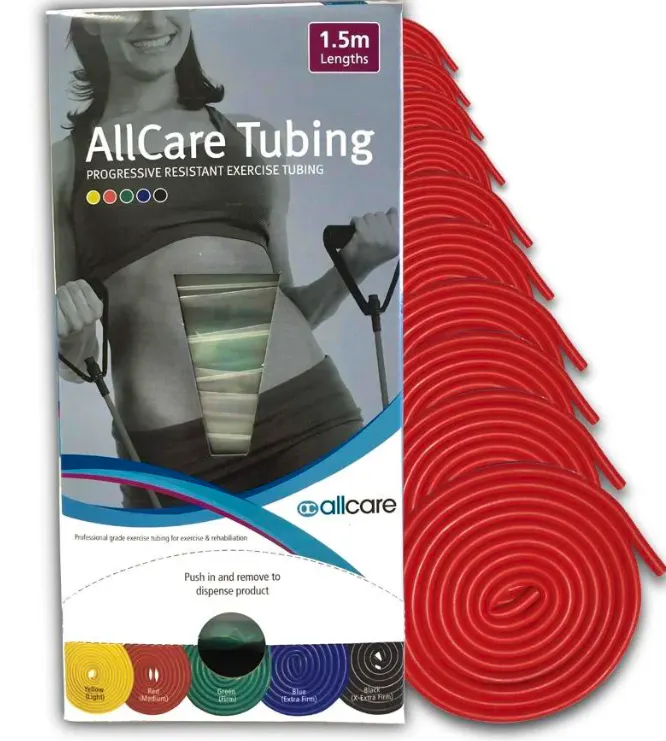
Professional-grade tubing for prescribed home exercise
AllCare Progressive Resistance Tubing is professional-grade latex resistance tubing manufactured under ISO 9002 quality standards.
It is used widely in physiotherapy, chiropractic, and occupational therapy settings across Australia and internationally. The 1.5-metre pre-cut length is the patient take-home version of the clinical dispensing rolls used by practitioners.
It is sold as individual 1.5m lengths, colour-coded by resistance level, making it easy to prescribe the correct starting resistance and progress systematically as strength improves.
The tubing can be used as a full-length piece, folded to shorten it and increase resistance, or tied into a loop. It is compatible with AllCare exercise handles and door anchor stirrups, sold separately, for expanded exercise options.
Colour-coded progression from light rehab to advanced training
Each colour represents a distinct resistance level with a consistent approximate 30% increase from one colour to the next.
| Colour | Resistance Level | Typical Use |
|---|---|---|
| Yellow | Light | Initial rehabilitation, elderly patients, post-surgical early phase |
| Red | Medium | General rehabilitation, home exercise programs, moderate conditioning |
| Green | Extra / Firm | Intermediate rehabilitation, sports rehab, upper limb strengthening |
| Blue | Extra Firm | Advanced rehabilitation, athletic conditioning |
| Black | X-Extra Firm | High-resistance training, advanced athletes |
Controlled resistance for rehabilitation and strengthening
Progressive loading
Provides controlled resistance for rehabilitation and strengthening across all major muscle groups and joints.
Natural loading curve
Elastic resistance increases proportionally with stretch, unlike free weights that provide constant load regardless of joint position.
Targeted exercise
Allows precise exercise of specific muscle groups and joints without gym equipment.
Full-range movement
Supports resistance through a full range of motion, useful for controlled joint rehabilitation.
Expandable setup
Compatible with door anchors and handles for a wider variety of exercise positions.
Common rehabilitation and conditioning applications
- Post-injury and post-surgical rehabilitation: Allows progressive loading from minimal resistance through to significant resistance as tissue healing and strength permit.
- Rotator cuff rehabilitation: Useful for shoulder external rotation, internal rotation, and scapular exercises for rotator cuff tendinopathy, impingement, and post-surgical repair.
- Cervical and scapular strengthening: Supports scapular retraction, shoulder depression, and cervical stabilisation exercises for forward head posture, neck pain, and upper crossed syndrome.
- Lower back rehabilitation: Can be used for hip extension, hip abduction, and trunk stabilisation to build active stability.
- Lower limb rehabilitation: Standard for ankle, knee, and hip strengthening after ligament sprains, knee surgery, and hip stabilisation programs.
- Sporting and athletic conditioning: Useful for swimmers, throwers, and overhead athletes who require rotator cuff and scapular strength training.
- Evidence context: Elastic resistance training is extensively studied and can produce strength and functional outcomes comparable to conventional weight-based training in rehabilitation populations.
Use the resistance prescribed by your chiropractor
- Always use the resistance level prescribed by your chiropractor. Do not skip ahead to a heavier colour without guidance.
- To use as a loop, tie a secure knot at both ends to form a closed loop. Ensure the knot is secure before loading it with resistance.
- To use as a single length, anchor one end to a door anchor, under your foot, or around a stable post, and hold or loop the other end around your hand or use handles.
- A typical rehabilitation session involves 3 to 5 sets of 15 repetitions. Progress sets, reps, and resistance only at your tolerance.
- If swelling or pain increases during or after a session, reduce the resistance or volume and consult your chiropractor.
- Perform exercises in a smooth, controlled manner. Do not snap or jerk the tubing.
- Inspect the tubing before each use for cracks, tears, or weak spots in the latex. Do not use damaged tubing.
- Store away from direct sunlight and heat, which degrade latex over time. Keep away from sharp objects.
Important — please read before use
- This product contains latex. Do not use if you have a known latex allergy.
- Always use the resistance level and exercise program prescribed by your chiropractor.
- Self-prescribing the wrong resistance or exercises can delay recovery or cause injury.
- Inspect the tubing before each session. Discard and replace if cracks, tears, splits, or discolouration are present.
- Do not snap the tubing or allow it to recoil rapidly against skin.
- Do not anchor around sharp edges or objects that could cut the tubing during exercise.
- Resistance tubing is a rehabilitation and exercise tool. It does not replace chiropractic assessment or treatment of the underlying injury or condition.
1.5m pre-cut exercise tubing
Red medium resistance tubing shown
Individual 1.5m lengths are available in colour-coded resistance levels from Yellow Light to Black X-Extra Firm.

